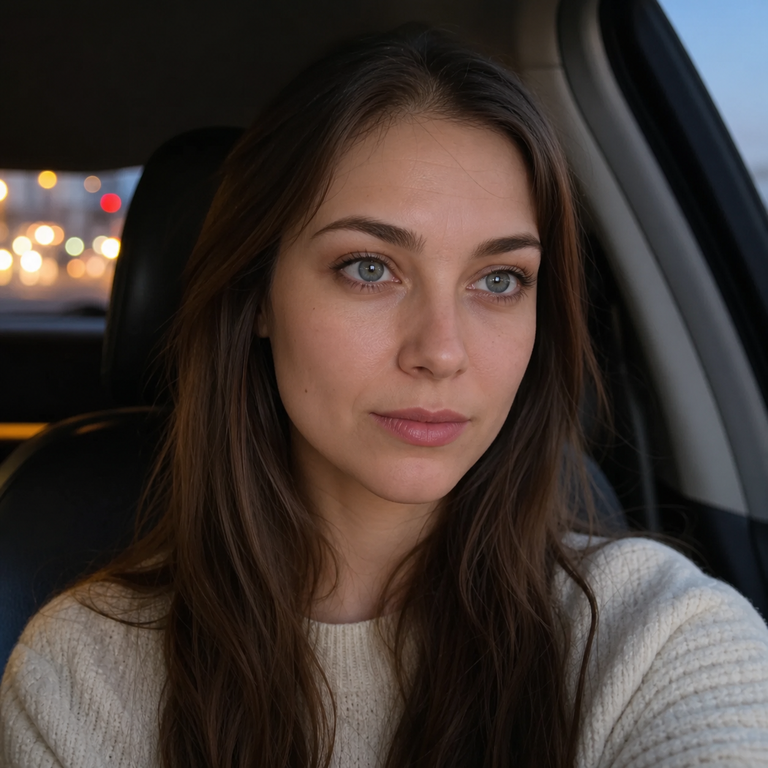
The sun has dropped behind the buildings, the road is wet, and every oncoming headlight has started to bloom against the windshield. You are still parked. Your colored contacts felt ordinary in the afternoon, but the dashboard now looks a little softer and the edge of one lens seems noticeable after each blink. This is the point to decide, not after merging into traffic.
You may drive at night in properly prescribed and fitted colored contacts only if your vision remains clear and stable, your contrast and glare tolerance feel normal, and your eyes are comfortable. A prescription and good fit do not create universal permission to drive. If the lenses change vision, contrast, glare tolerance, comfort, or stability, do not drive. Remove them when you can do so safely, use an appropriate alternative, and contact an eye-care professional.
Why a lens that seems clear by day can feel different after dusk
Night driving is not simply daytime driving with fewer photons. Your visual system has to find lane markings, pedestrians, cyclists, road debris, and signs against darker backgrounds. It must also recover from bright points of light without losing track of what sits beside them. A standard high-contrast eye chart can be reassuring, yet it does not reproduce a dark road with rain, glare, and movement.
The National Eye Institute’s explanation of how the eyes work notes that light enters through the pupil and that the iris controls how much light the pupil lets in. In dim conditions, the pupil generally becomes larger so more light can enter. That larger opening is relevant to a colored lens because it may approach the border between the lens’s clear central pupil zone and its printed or tinted region.
During bright daytime conditions, a smaller pupil may sit well inside the clear optical opening. At dusk, a larger pupil can expose the visual system to more of the transition zone or printed pattern, depending on the lens design, its position, and the wearer’s pupil size. The possible result is not always dramatic blur. It may be a faint ring, haze, shadowing, reduced crispness, or more noticeable halos around lights.
Pupil size varies with illumination and among people. Lens designs also vary in the diameter and treatment of the clear zone. That is why one person’s uneventful drive, or one lens that worked acceptably, cannot authorize another person or another design.
The clear pupil zone and printed periphery have different jobs
A typical cosmetic colored lens uses pigment or an opaque-looking pattern outside a central clear zone. The print changes the apparent iris color; the clear opening is intended to allow light through toward the pupil. Those features have to interact with a living eye, not a fixed diagram. The lens rests on the tear film, can move with blinking and gaze, and may not remain perfectly centered every second.
If the pupil expands beyond the unobstructed portion of the design, or if the lens shifts enough for print to overlap the line of sight, visual quality may change. A subtle overlap can matter more on a dark road than in a bright room because the task depends heavily on low-contrast detail. If you already notice a colored edge, intermittent veil, or changing clarity indoors under dim lighting, treat that as a warning rather than something to “get used to” behind the wheel.
An older paper indexed as PMID 12482252 analyzed the optics of contact lenses with opaque and semi-opaque peripheral zones. It used paraxial calculations and finite ray tracing to consider fields of illumination and extended the analysis to semi-opaque cosmetic peripheries. The paper helps explain how aperture size, pupil size, and peripheral opacity can affect retinal illumination.
It does not prove that every cosmetic lens restricts every driver’s visual field. It was an optical analysis, not a road-driving trial of all current colored lenses. Its practical value is narrower: printed peripheries and clear apertures are optically relevant, so a specific lens on a specific eye should be assessed rather than treated as interchangeable with every other colored lens.
Contrast sensitivity and glare can matter before acuity looks “bad”
Visual acuity is the ability to resolve fine, high-contrast detail, such as dark letters on a bright chart. Contrast sensitivity describes how well you can distinguish an object from a background when the difference between them is smaller. Night driving often leans on the second ability: a person in dark clothing near a shadowed curb, a faded lane line, or an unlit object on asphalt may not offer strong contrast.
Glare adds another layer. Headlights and streetlights can scatter or flare, temporarily making nearby low-contrast details harder to locate. A wearer might still read a license plate under a lamp yet feel that oncoming lights wash out lane boundaries. That mismatch is one reason “I can see 20/20” is not a sufficient self-clearance for driving.
A study indexed as PMID 34840675 examined 34 medical students. Investigators measured visual acuity and contrast sensitivity without lenses and with a clear lens on one eye and a colored lens on the other, under normal, mesopic, and glare conditions. They reported lower contrast sensitivity with both clear and colored contact lenses compared with the no-lens condition, and lower contrast sensitivity in mesopic and glare conditions than in normal lighting.
This is useful evidence of a plausible night-vision concern, but its scope matters. The sample was small and specific, the work measured visual performance under test conditions, and it did not establish a crash rate or a pass-fail rule for every lens wearer. It supports caution and individualized assessment. It does not support claiming that all colored contacts make all night driving unsafe.
Fit, movement, tear film, and prescription all affect the answer
A colored lens can have an adequately sized clear zone and still perform poorly if it does not sit or move as intended. Too much movement may cause transient blur after a blink or glance. Decentration may bring part of the print closer to the visual axis. A lens that moves too little can also be associated with an unhealthy or uncomfortable fit. These are clinical fit questions, not problems to solve by tolerating the lens longer.
The tear film matters too. Contact lenses divide the tear film into layers, and dryness can make vision fluctuate. Heater or air-conditioning vents, prolonged concentration, and reduced blinking can make a marginal situation more noticeable in a car. If a blink clears the image only briefly, vision is not stable enough to dismiss the issue.
Your refractive prescription must also be current and supplied in the lens parameters prescribed for you. Decorative lenses without vision correction are still contact lenses. In the United States, the FDA treats decorative contacts as medical devices and says they require a prescription. Read more about eye exams for colored contacts and what happens during a contact lens fitting if the difference between an eye exam and a lens fit is unclear.
A fitting gives the eye-care professional a chance to evaluate lens position, coverage, movement, surface behavior, and your vision with the lens on the eye. For a wearer who expects to drive after dark, it is reasonable to mention that use case and any symptoms noticed at dusk, under headlights, or in rain. Bring the exact lens packaging or brand details rather than describing it only as a gray or brown contact.
A practical night-driving decision table
Use the table while still parked. It is a stop-or-proceed screen, not a substitute for an examination, a licensing requirement, or professional advice.
| What you notice before driving | What it may mean | Safer decision |
|---|---|---|
| Vision is clear, stable after blinks, comfortable, and comparable with your usual corrected vision; glare does not seem increased | No obvious lens-related change is apparent at that moment | Driving may be reasonable if the lenses were prescribed and fitted, you meet legal vision requirements, and conditions stay stable |
| A colored ring, haze, halos, ghosting, or softer detail appears as lighting dims | The enlarged pupil, lens optics, print transition, tear film, or prescription may be affecting visual quality | Do not drive in the lenses; use a suitable alternative and arrange an eye-care review |
| Clarity changes after blinking, looking sideways, or moving your eyes | The lens may be moving, decentering, drying, or otherwise behaving unstably | Do not drive until the cause has been assessed |
| Headlights feel newly dazzling or lane lines fade beside glare | Glare tolerance or contrast performance may be reduced | Do not start the trip; change transportation or correction |
| Redness, pain, discharge, light sensitivity, or decreased vision occurs | Possible eye irritation, injury, or infection | Remove the lenses when safe and seek prompt eye-care advice; urgent assessment may be needed |
Check the lenses in relevant conditions before you need the car
Make the assessment before a necessary evening drive, not at the curb when you are already late. Start with the basics: the correct lens for each eye, clean hands, undamaged lenses, the prescribed wear schedule, and adequate time for the lenses to settle. Never use a roadway as the first test environment for a new design.
Then compare what you see through each eye and with both eyes in a safe, stationary setting. Look at ordinary low-contrast details, not only a bright phone screen. Notice whether a blink changes sharpness, whether a printed edge enters vision, and whether distant lights appear more spread out than with your usual correction. A phone flashlight, a dark room, or a quick mirror check cannot reproduce the full driving task, so do not turn this into a home certification test. The aim is to catch obvious reasons to stop.
Persistent or recurring blur deserves attention even if it appears only after sunset. The guide on why colored contacts can look blurry covers several possible contributors, but self-diagnosis should not replace an exam. Bring notes about timing: whether symptoms begin immediately, after hours of wear, only in dim light, or mainly around glare. Specific observations are more useful than saying the lenses feel “off.”
Keep backup correction available if your eye-care professional has prescribed it. Some people use glasses for driving even when contacts are comfortable for other activities. Others may have glasses intended to be worn over contacts for residual correction, but that combination must match the prescription plan. See when colored contacts and glasses may be worn together; do not improvise by stacking corrections.
Prescription status is necessary, but it is not a night-driving guarantee
The FDA’s decorative contact lens guidance states that all contact lenses, including decorative lenses, must be prescribed by a doctor. It also emphasizes proper fit, care instructions, follow-up exams, and prompt attention to redness, ongoing pain, discharge, or decreased vision. Buying a cosmetic lens without a prescription removes safeguards that are directly relevant to visual quality and eye health.
FDA clearance or approval concerns lawful medical-device oversight; it is not a personalized promise about driving performance. A compliant product still needs the correct prescription, brand and measurements, professional fitting, proper care, and appropriate wear on a healthy eye. Yilala’s overview of FDA compliance for colored contacts explains the regulatory side, but the road decision still turns on how the prescribed lens performs for the individual wearer.
Likewise, a driver’s license vision standard is a legal threshold, not a complete description of performance in rain, fog, glare, or fatigue. Follow state requirements and any restrictions on your license, but use a stricter personal stop rule when a lens introduces blur, unstable vision, reduced contrast, or discomfort.
When the answer should be no
Do not drive in colored contacts when vision is blurred or fluctuating, print intrudes into sight, halos or glare are newly worse, contrast seems reduced, or the lens feels displaced. Do not drive through pain, marked redness, discharge, light sensitivity, or decreased vision. Those symptoms are not inconveniences to balance against a short trip.
If trouble begins while you are already driving, reduce risk without making abrupt lens adjustments. Signal, leave traffic, and stop in a safe legal location. Arrange another driver, a ride, or your prescribed backup correction if it can be used safely. If symptoms suggest injury or infection, remove the lenses once safely parked and follow prompt medical guidance. The FDA advises seeing a licensed eye doctor right away for signs such as redness, persistent pain, or decreased vision.
Even without urgent symptoms, repeated night-only problems justify an eye-care appointment. Ask the professional to review the prescription, ocular surface, fit, centration, movement, clear-zone relationship, and whether another correction strategy is more suitable for evening driving. A different diameter, design, material, replacement schedule, or non-contact option might be discussed, but the correct response depends on the examination.
Frequently Asked Questions
Are colored contacts legal for night driving in the United States?
There is no single federal rule that grants or bans night driving solely because a lens is colored. The driver must meet applicable state vision and license requirements. Decorative contacts still require a prescription, and you should not drive if they alter clarity, contrast, glare tolerance, comfort, or stability.
Why do my colored contacts blur only at night?
In dim light, the pupil usually enlarges. Depending on pupil size, lens centration, movement, tear-film quality, and the diameter of the clear zone, the printed transition may become more visually relevant. Dryness or an outdated prescription can also cause fluctuating blur. Stop driving in the lenses and arrange an eye-care review.
Can the colored ring block peripheral vision?
Opaque or semi-opaque peripheral designs can affect illumination under some optical conditions, but the cited optical analysis does not prove that every modern cosmetic lens restricts every wearer’s field. Design, aperture size, pupil size, fit, and position matter. A noticed shadow or field change needs professional assessment.
Do clear contact lenses also affect night contrast?
They can. PMID 34840675 reported lower contrast sensitivity with both clear and colored soft contacts than with no lens in its sample, and lower sensitivity under mesopic and glare conditions. That study does not predict every wearer’s result, but it shows that color is not the only relevant variable.
Can I test colored contacts by driving around the block?
No. Public-road driving is not an appropriate lens test. Screen for obvious problems while stationary, and discuss night use with the professional who fitted the lenses. A short familiar route cannot establish how you will perform with rain, fatigue, unfamiliar roads, or sustained glare.
Will eye drops make colored contacts suitable for night driving?
Lubricating drops approved for use with your lenses may help dryness when recommended, but they cannot correct an unsuitable fit, print overlap, wrong prescription, or reduced contrast. If drops seem necessary to make vision acceptable for driving, pause night driving and ask your eye-care professional what is causing the change.
Should I switch to glasses for driving after dark?
Glasses may be a sensible backup when they provide the stable correction prescribed for you. Do not assume any old pair is adequate, and do not wear extra glasses over contacts unless that combination was prescribed. Ask which correction should be used for driving and keep it accessible.
What symptoms require prompt eye-care attention?
Remove the lenses when you can do so safely and seek prompt advice for redness, persistent pain, discharge, light sensitivity, or decreased vision. Sudden or severe symptoms may require urgent care. Do not drive yourself if vision is impaired; arrange transportation.
Official Sources
- National Eye Institute: How the Eyes Work
- U.S. Food and Drug Administration: Decorative Contact Lenses
- PubMed PMID 34840675: Effect of Contact Lenses on Contrast Sensitivity under Various Lighting Conditions
- PubMed PMID 12482252: Field Restriction and Vignetting in Contact Lenses with Opaque Peripheries
The parked-car decision is the useful one
Colored contacts do not receive a blanket pass for night driving just because they are prescribed, comfortable in daylight, or sold as decorative rather than corrective. The useful question is whether this exact prescribed lens stays clear, centered, comfortable, and visually neutral for this wearer under the conditions ahead. Any change in clarity, contrast, glare tolerance, comfort, or stability makes the decision simple: do not drive in it.
If your eye-care professional has already confirmed the prescription, fit, and suitable uses, you can view Yilala’s Illusory Series colored contact lenses as one cosmetic option to discuss. This link makes no claim or promise about night-driving performance. Individual assessment still governs whether any colored lens should be worn behind the wheel.
When in doubt at dusk, keep the keys down. Choose your prescribed backup correction or another ride, then have the lens evaluated before the next night trip.