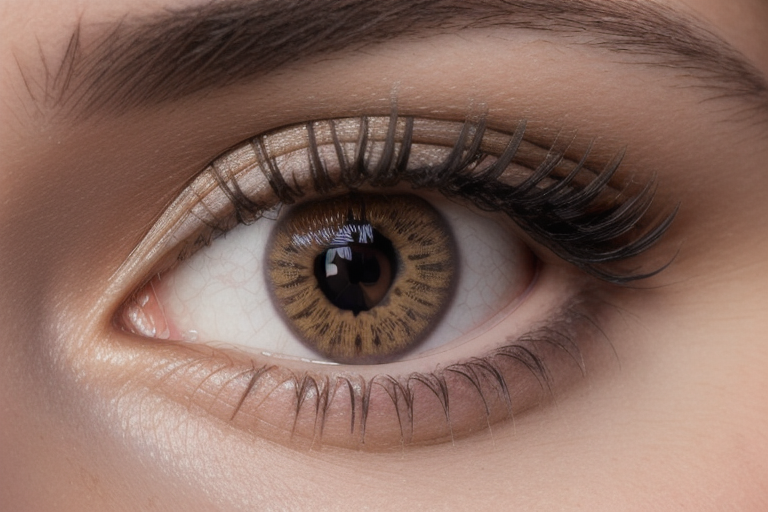
You saw the photos online. The lenses looked perfect — soft, natural, barely-there color. Then you ordered a pair and wore them to work, and a coworker immediately asked why your eyes looked different. That gap between photos and real life is where most colored contacts fail.
The difference is rarely the color itself. It is how the lens behaves on your actual eye, under actual lighting, at actual conversation distance. Here is what separates lenses that look natural in person from the ones that only look good in edited photos.
Why Some Lenses Only Look Good in Photos
Three things make a lens look artificial in person. First, a harsh limbal ring — the dark circle around the iris. In a filtered photo the ring reads as definition. In real life it reads as an obvious outline around your eye. Second, uniform opacity. A lens with one flat color across the entire iris looks painted, because real irises have variation. Third, a diameter that extends too far onto the white of the eye, which is visible from across a room.
Filters hide all three. Brightness adjustments wash out the ring. Saturation tweaks blend the flat color. Cropping removes the outer edge of the lens. The photo looks natural because the flaws were edited away, not because the lens was ever natural to begin with.
What a Natural-Looking Lens Actually Has
| Feature | What It Does | Why It Matters in Person |
|---|---|---|
| Graduated limbal ring | Fades from dark to light | No harsh outline at arm’s length |
| Layered iris pattern | Multiple tones, not one flat color | Mimics the variation of a real iris |
| 14.5mm diameter | Extends just past the iris | Subtle enlargement without crossing into the white |
| Sealed-in pigment | Color inside the hydrogel | No surface texture that catches light oddly |
Which Colors Read as Natural
On dark eyes, the most natural colors are the ones that exist in real irises: hazel, soft brown, and muted grey. A hazel lens that layers gold and green over your natural brown reads as “interesting eyes,” not “wearing contacts.” A soft grey reads as a cool-toned eye color. Avoid anything more than two shades from your natural color if you want the change to go unannounced.
On light eyes, the same logic applies in reverse. The Earl Series brown deepens light eyes without a jarring shift. A subtle deepening reads as natural variation, not a color swap.
Test Before You Commit
Wear the lenses for a full day before deciding. Check them in three lighting conditions: morning window light, fluorescent office light, and evening lamp light. Look at yourself from conversation distance in a mirror — about three feet, not six inches. If the color reads clearly and the ring is not visible at three feet, the lenses pass the natural test. If you can see an outline at three feet, the lens will look artificial to everyone you talk to.
Browse lenses designed to pass the conversation-distance test.
FAQ
Can colored contacts look completely natural in person? Yes, if the lens has a graduated limbal ring, layered iris pattern, and a color within two shades of your natural eye color. The more the lens mimics real iris anatomy, the more natural it looks at conversation distance.
Why do my lenses look different in photos than in the mirror? Photos apply brightness, saturation, and contrast adjustments that hide lens flaws. The mirror shows the lens as it actually looks. If a lens only looks good in photos, it does not look natural in person.
What diameter looks most natural? A 14.5mm diameter extends just past the natural iris, creating subtle enlargement without a visible edge. Anything larger starts to look artificial because the lens crosses visibly onto the white of the eye.
Which colors read as most natural on dark eyes? Hazel, soft brown, and muted grey read as natural on dark eyes because they exist in real irises. Bright blue, vivid purple, and light green read as colored contacts because they are rare in dark-eyed people.
Does the limbal ring matter that much? Yes. A solid dark ring is the single most obvious tell of a colored contact in person. A graduated ring that fades into the iris is barely visible at conversation distance.
How can I test if a lens looks natural before wearing it out? Wear it for a full day, check it in morning light, fluorescent light, and evening light, and look at yourself from three feet away in a mirror. If the outline is invisible at three feet, the lens passes.