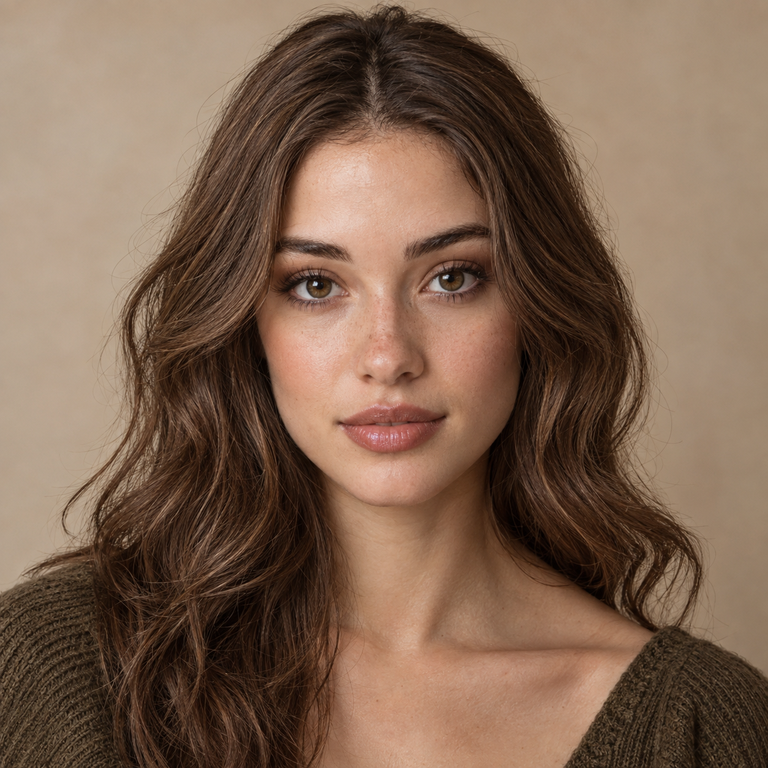
My direct answer: if your styling brief calls for the Muse collection’s coffee-named option, I would shortlist Muse Coffee; if it calls for the Olive collection’s brown option, I would shortlist Olive Brown. I cannot turn those names into a reliable claim about on-eye tone, opacity, enlargement, comfort, or the result on dark eyes. In the United States, either choice requires a valid contact-lens prescription and a proper fitting by a licensed eye-care professional, including when the power is 0.00. Colored contacts are medical devices, not ordinary beauty accessories, and incorrect fit, wear, or care can injure the eye.
That concise distinction is the most honest place for me to begin. The two live listings share several headline specifications, yet they are different products with different model numbers and collection stories. I compare them as a brand editor working from current catalog details, product photography, and a styling brief. I have not worn or clinically tested either lens. My task is to help you organize the visual decision before your prescriber decides whether either exact product is suitable for your eyes.
The comparison I can make responsibly
Muse Coffee is a named color in the Muse Series, model HE1101. The current page places it beside Muse Brown and Muse Grey and describes the collection through an artistic, classic-beauty direction. Olive Brown is a named color in the Olive Series, model HC1419. Its page places it beside Olive Blue and Olive Grey and frames the collection with an earthy, Mediterranean-inspired direction.
I use those descriptions only as creative positioning. They can guide a wardrobe board, makeup palette, location choice, or photography concept. They do not establish what pigment will dominate once the lens is centered over a particular iris. The words coffee and olive brown are catalog labels, not standardized color measurements. Even a carefully lit product image is not a controlled prediction for every wearer.
My practical editorial distinction is therefore collection-led. Muse Coffee belongs on a board that already speaks in coffee, cocoa, ink, soft tailoring, and quiet studio light. Olive Brown belongs on a board built around olive cloth, sand, linen, worn leather, muted foliage, and sun-washed neutrals. These are styling associations, not statements about the lens’s measured undertone or visible coverage.
Muse Coffee vs Olive Brown specifications
The current listings provide a useful factual baseline. I checked each selector and specification block rather than assuming that one family represented the other. The shared values are worth seeing, but the different model identity matters just as much.
| Catalog point | Muse Coffee | Olive Brown | What I take from it |
|---|---|---|---|
| Series and model | Muse Series, HE1101 | Olive Series, HC1419 | They are distinct product models. |
| Listed material | HEMA+NVP | HEMA+NVP | A shared material label does not determine personal comfort. |
| Diameter | 14.2 mm | 14.2 mm | The number alone does not establish an enlargement effect or proper fit. |
| Base curve | 8.6 mm | 8.6 mm | A matching printed curve does not make two designs interchangeable. |
| Water content | 38% | 38% | This figure cannot predict an individual’s wearing experience. |
| Displayed powers | 0.00 and minus powers from -1.00 to -4.50 | 0.00 and minus powers from -1.00 to -4.50 | The menu is not a prescription or fit approval. |
| Listed replacement timing | Six months after opening | Six months after opening | This is an outer replacement point, not permission for continuous wear. |
| Named neighboring colors | Muse Brown, Muse Grey | Olive Blue, Olive Grey | Each option belongs to a different three-color family. |
The visible power menus include 0.00, then -1.00 through -4.50 in 0.25 steps. They do not display plus powers, toric parameters for astigmatism, or multifocal options. I would never convert an eyeglass prescription into one of those menu values myself. Contact-lens prescribing considers the lens and how it behaves on the eye, not just a familiar sphere number.
The shared 14.2 mm diameter and 8.6 mm base curve may make these pages look technically parallel. I do not read that as evidence of equal fit, movement, centering, vision, or comfort. HE1101 and HC1419 remain different model identifiers, and a professional fitting evaluates the exact prescribed lens. A specification match on a shopping page is a comparison clue, not a clinical conclusion.
How I read the product photography
I treat campaign images as references for art direction. First I note the crop, light source, contrast, skin rendering, makeup, wardrobe, and post-processing. Then I ask whether the image helps me imagine a complete look. I do not use it to promise that the lens will reproduce the same color on another iris or in another camera.
For Muse Coffee, I would build a photo brief around restrained indoor light, matte brown textiles, brushed metal, and a clean tonal makeup story. For Olive Brown, I would explore diffused daylight, stone, khaki, cream, and botanical texture. Either concept can be reversed or mixed. The point is not that a lens forces a palette. The point is to give each catalog choice a coherent environment so I can compare intentions rather than two isolated names.
I also separate visible styling from claims the image cannot prove. A photographed iris may begin lighter or darker than yours. The pupil may be a different size. Flash, window light, white balance, exposure, sharpening, and screen calibration can all affect what you perceive. Lens centering and the visible interaction between the print and natural iris also belong to the individual fitting and viewing situation.
This is why I do not say Muse Coffee is deeper, softer, cooler, or more opaque than Olive Brown. I do not say Olive Brown will appear warmer, greener, subtler, or larger. The live names and collection copy are not enough to support those comparisons. If those properties decide your purchase, ask Yilala for directly comparable, minimally processed references and discuss the exact product with your eye-care professional.
My styling fork for real wardrobes
When a client brief contains no medical or performance question and only asks which creative route to explore, I start with the language already present in the closet. Coffee, espresso, chocolate, taupe, charcoal, burgundy, and tailored black make Muse Coffee the cleaner naming connection. Sage, moss, camel, cream, denim, terracotta, and natural fibers make Olive Brown the cleaner connection. This method is about palette continuity, not predicted eye color.
For a workwear board, I might place Muse Coffee beside a fine-gauge knit, a brown liner, a muted lip, and minimal jewelry. I might place Olive Brown beside an unstructured jacket, an ivory shirt, a soft cheek color, and textured gold. For evening, I could sharpen either direction with black, satin, and a more deliberate lash. Neither route carries a promise of naturalness or drama.
For photography, I would request the same camera, exposure approach, lens, distance, light position, and white-balance method for both products. I would also record the model’s starting iris color without treating that model as universal. A controlled comparison makes the creative review more useful, though it still does not replace a fitting or predict another person’s result.
If you want a wider brown shortlist before deciding, my natural brown colored contacts edit places Muse Coffee and Olive Brown among other live Yilala brown options. If you are already drawn to the Olive family, the Olive Series comparison shows how I separate Brown, Blue, and Grey without turning collection language into on-eye certainty.
What the shared material and numbers do not tell me
Both pages list HEMA+NVP and 38% water content. I report those as catalog facts. I do not translate them into all-day hydration, breathability, dryness resistance, or a comfort promise. A material family and water percentage are only part of a lens design and only part of a wearer’s response. Tear film, ocular surface health, environment, handling, wear time, fit, and prescribed care can matter.
Likewise, a 14.2 mm total diameter is not the same thing as a published graphic diameter, and neither product page gives me evidence for a quantified enlargement comparison. I will not infer a limbal-ring effect or visible eye-size change from the total diameter or images. If enlargement is central to your brief, request the relevant technical detail rather than guessing from a photograph.
The same restraint applies to opacity and dark-eye performance. I cannot classify one as more covering from its shade name. I cannot promise either will remain distinctly brown, reveal a green cast, or blend invisibly on a dark iris. For a useful education-first overview of lens categories and selection questions, see Yilala’s complete guide to colored contact lenses, then bring the product-specific questions back to the seller and prescriber.
Prescription, fit, and medical-device status
The FDA states that decorative contacts are medical devices rather than cosmetics or over-the-counter merchandise. It says a licensed eye doctor must measure each eye, evaluate the response to contact-lens wear, and issue a valid prescription that includes the brand name, lens measurements, and an expiration date. That requirement applies even when a decorative lens does not correct vision. Read the FDA’s colored and decorative contact lens guidance before treating 0.00 as a casual option.
For me, this changes the shopping order. I can choose a visual direction, but I do not complete a purchase by matching the web selector to my glasses. I take the exact Muse HE1101 or Olive HC1419 information to a licensed eye-care professional, obtain a current contact-lens prescription, and buy only through a channel that verifies it. If the professional does not prescribe that product, I return to the visual brief and look for an appropriate prescribed alternative.
The FDA also warns that poor fit can contribute to corneal scratches, infection, conjunctivitis, decreased vision, and blindness. That is why two shared headline measurements never become my shortcut to interchangeability. Yilala’s colored-contact safety guide can support a pre-purchase checklist, but it does not replace individual clinical advice.
How I interpret the six-month replacement listing
Both product pages say six months after opening. I read that as the listed maximum replacement interval for a reusable product under its labeling, prescribed schedule, and correct care. I do not read it as six months of uninterrupted wear, permission to sleep in the lenses, or a target that overrides damage, contamination, symptoms, or professional advice.
The clock begins when the package is opened, not when the pair reaches a certain number of outings. I would write the opening date down, follow the eye-care professional’s schedule, inspect the lenses as instructed, and replace them earlier if the professional or labeling says to do so. A long replacement interval also means the cleaning and storage routine matters every time the lenses are removed.
The CDC explains that contact lenses are medical devices and that failure to wear, clean, and store them as directed raises the risk of eye infections such as microbial keratitis. Its contact lens overview is a useful reminder that reusable does not mean low-maintenance. I keep the replacement date and daily wear time as separate instructions.
My care and stop-wear checklist
I wash and thoroughly dry my hands before handling a lens, then use the care system prescribed for that lens. I use fresh contact-lens solution rather than water or saliva, and I never top off old solution in a case. I keep lenses away from shower, pool, bath, and hot-tub water. I do not share lenses. I do not sleep in them unless the exact lens is prescribed and labeled for that use, and these product pages direct users to remove them before sleeping.
The National Eye Institute advises removing contacts for eye pain, redness, light sensitivity, sudden blurry vision, unusual watering, or discharge, and contacting an eye doctor if symptoms persist or worsen. Its contact lens care page also recommends fresh solution, no water or saliva, and regular case replacement. I treat symptoms as a stop signal, not a styling inconvenience.
MedlinePlus notes that wearing soft contacts overnight may cause a corneal ulcer and that untreated corneal ulcers and infections can lead to severe vision loss or corneal scarring. Its corneal ulcers and infections reference supports prompt professional care when pain, worsening redness, swelling, or affected vision appears. If something feels wrong, I remove the lenses and seek clinical guidance rather than attempting to rescue the look.
My final comparison verdict
I would choose the name that completes the intended style story, then let prescription and fitting decide whether the product can enter the plan. Muse Coffee is my Muse-led coffee brief. Olive Brown is my Olive-led earthy brief. That is a meaningful creative distinction, but it is deliberately narrower than a claim about what either lens will do on an eye.
If both styling directions work, I would compare the live product pages side by side, confirm current availability and exact parameters, save references from comparable lighting, and show the model numbers to my eye-care professional. I would not break a tie by assuming that shared HEMA+NVP, 14.2 mm, 8.6 mm, and 38% figures mean the same fit or feel.
Once you have a valid US contact-lens prescription for the exact lens and professional fitting guidance, review the Yilala natural-look lens collection and return to the Muse and Olive pages for the current selectors. Let the visual brief narrow the color, and let eye care set the boundaries.
Frequently asked questions
What is the main difference between Muse Coffee and Olive Brown?
Muse Coffee is a color option in the Muse Series, model HE1101, while Olive Brown is in the Olive Series, model HC1419. I use their different collection stories to organize styling concepts. I do not treat the names as proof of a particular on-eye shade, undertone, opacity, or level of change.
Do Muse Coffee and Olive Brown have the same specifications?
The live pages list the same material, 14.2 mm diameter, 8.6 mm base curve, 38% water content, visible power range, and six-month-after-opening replacement timing. They still have different model numbers. Shared summary specifications do not prove identical design behavior, fit, comfort, centering, or visual result.
Which one will look more natural on dark brown eyes?
I cannot verify that from the names or catalog photos. Starting iris color, pupil size, lens print, centering, fit, light, camera settings, and editing can affect appearance. I would request directly comparable references, avoid promising a fixed outcome, and use only the exact lens prescribed and fitted by an eye-care professional.
Which lens is more opaque or enlarging?
The live pages do not give me enough verified information to rank opacity or enlargement. A shared 14.2 mm total diameter does not by itself establish visible enlargement, and photography does not measure coverage. Ask for relevant technical details rather than inferring either property from the shade names.
Can I order either color in prescription power?
Both current menus display 0.00 and minus powers from -1.00 to -4.50 in 0.25 steps. The displayed range does not include every vision need and is not a prescription. A licensed eye-care professional must prescribe the exact contact lens and power after evaluating your eyes and fit.
Do I need a prescription if I select 0.00?
Yes, in the United States. The FDA regulates decorative contact lenses as medical devices and requires a valid prescription even when they do not correct vision. Plano means zero corrective power; it does not mean that the lens is an over-the-counter cosmetic or that fitting is optional.
Can I wear a pair continuously for six months?
No. The listing says replacement six months after opening, not continuous wear. Remove, clean, disinfect, and store reusable lenses exactly as directed, follow the wear time set by your eye-care professional, keep them away from water, and do not sleep in these lenses.
When should I stop wearing colored contacts and call an eye doctor?
Remove the lenses for pain, notable redness, light sensitivity, sudden blurred vision, unusual watering, discharge, swelling, or other concerning changes. Seek prompt eye-care advice, especially if symptoms persist, worsen, or affect vision. Do not reinsert a lens simply to complete an outfit or photo session.