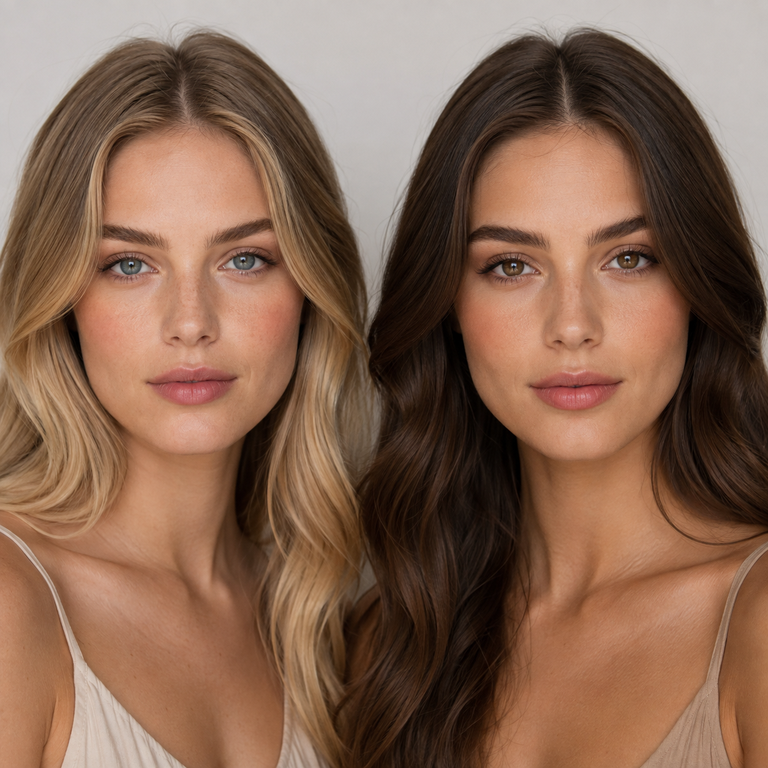
My short answer: I compare Muse Grey and Muse Coffee by color direction, not by a promise about how either lens will look on every eye. Choose Muse Grey if your brief specifically calls for a cool gray label; choose Muse Coffee if it calls for a warmer brown-family label. Both are color options within the same Yilala Muse Series listing, model HE1101, and the page gives them the same published material, diameter, base curve, water content, power range, and replacement statement. In the United States, colored contacts are prescription medical devices, even at 0.00 power, so the real first choice is a valid prescription and professional fitting.
I am writing this as a Yilala catalog editor, not as a wearer reporting a personal trial. I have not put these lenses on, and I will not invent claims about comfort, opacity, enlargement, coverage, or the final color on a particular iris. The comparison below stays with the live product listing, the two shade names, and the practical questions I would use to organize a purchase decision. The FDA states that decorative contacts require a prescription and are not one-size-fits-all, which matters more than a color preference.
Muse Grey vs Muse Coffee at a Glance
The cleanest way to separate these options is to treat “Grey” and “Coffee” as catalog color directions. Grey is the cool-neutral route in the naming system. Coffee is the warm brown route. That distinction can help you build a shortlist, but a shade name is not a calibrated preview. Your natural iris color, pupil size, lighting, camera processing, makeup, and the specific lens print can all affect what you see. Because the live listing does not provide controlled comparison photography or technical color measurements for the two variants, I do not assign either one a promised level of brightness, subtlety, contrast, or coverage.
| Decision point | Muse Grey | Muse Coffee | What does not change |
|---|---|---|---|
| Catalog direction | Cool gray family | Warm coffee-brown family | Both are HE1101 Muse variants |
| Shortlist when | Your styling brief explicitly calls for gray | Your styling brief explicitly calls for warm brown | A valid prescription and professional fit come first |
| Published material | HEMA+NVP | HEMA+NVP | Shared specification |
| Published geometry | 14.2 mm diameter; 8.6 mm base curve | 14.2 mm diameter; 8.6 mm base curve | Numbers do not guarantee an individual fit |
| Published water content | 38% | 38% | Does not predict personal comfort by itself |
| Listed powers | 0.00 to -4.50 | 0.00 to -4.50 | Availability is not a prescription match |
| Listing replacement statement | 6 months after opening | 6 months after opening | Follow the label and prescriber instructions; discard sooner if directed |
If you are split between the two, I would not try to turn the shared specifications into a tiebreaker. They are the same on the listing. I would first confirm that the prescribed brand and parameters match, then choose the named color family that fits the wardrobe, character reference, or palette you are actually planning. For a broader color framework, our brown vs gray colored contacts guide explains how to structure that decision without promising an identical result across different eyes.
What the Live Muse Listing Actually Confirms
On the live page, Muse Grey and Muse Coffee appear beside Muse Brown as selectable colors in the Muse Series. The model is HE1101. The published material is HEMA+NVP, the diameter is 14.2 mm, the base curve is 8.6 mm, and the water content is 38%. The listed power choices run from plano 0.00 through -4.50, although not every possible contact lens prescription is represented. The product page describes the replacement cycle as six months after opening and identifies one pair per pack.
Those facts are useful for checking the product against a prescription and for avoiding confusion with another series. They do not establish that the lens is appropriate for your cornea, tear film, prescription needs, or wearing schedule. A diameter and base curve are only two fitting parameters. They also do not tell me how the gray or coffee print will interact with your iris. Our guide to BC, diameter, and water content gives more context on what those numbers can and cannot tell you.
I also separate the product page’s catalog data from health claims. The listing uses promotional comfort language, but I am not carrying that language into this comparison as a promised outcome. Shared HEMA+NVP material and 38% water content do not guarantee equal comfort from person to person, and they do not guarantee that two color variants will produce the same subjective experience. If your eye care professional has not prescribed this exact product and parameters, a matching number on a store page is not enough.
How I Compare the Two Color Names
My editorial method starts with the requested palette. “Grey” belongs in a cool or neutral brief. “Coffee” belongs in a warm brown brief. That is a naming distinction, not a clinical or optical measurement. I avoid phrases such as “more natural,” “more opaque,” or “better for dark eyes” unless the manufacturer provides controlled evidence that supports them. The current Muse listing does not provide enough variant-specific data for me to make those claims responsibly.
Next, I look at the context in which the color will be used. A wardrobe built around charcoal, silver, navy, or cool-toned styling may lead a shopper to shortlist the gray family. A palette built around camel, chocolate, bronze, or warm neutrals may lead a shopper to shortlist the coffee family. This is color coordination advice, not a forecast of the lens result. Fabric, screen settings, indoor bulbs, daylight, and white balance can shift how colors are perceived in photos and in person.
Finally, I ask whether the buyer is reacting to a real product reference or only to the name. If you have access to brand-provided images, check that they identify the exact variant and remember that an image is still not a guarantee for your own eyes. Do not use another shopper’s photo as fitting evidence. If your goal is a general everyday category rather than a particular Muse shade, our everyday colored contacts guide offers a wider decision process, while the Muse Series guide keeps the focus on this catalog family.
Why Shared Specs Do Not Settle Fit or Comfort
It is tempting to read “same series” as “same experience.” I do not make that leap. The FDA explains that decorative contact lenses are medical devices and that an eye doctor must measure each eye to fit lenses properly. Even a plano cosmetic lens requires a prescription in the United States. A glasses prescription is not a substitute for a contact lens prescription, and a power shown in a dropdown is not permission to self-select.
The two variants share the published 14.2 mm diameter and 8.6 mm base curve, but shared numbers do not guarantee the same fit, movement, centration, vision, comfort, or result for an individual. An eye care professional evaluates how a prescribed lens behaves on the eye and can account for information that a product table cannot. Our contact lens fitting guide outlines the appointment questions worth bringing to your provider.
The same restraint applies to material and water content. HEMA+NVP and 38% are identifying specifications on the listing. They are not a universal comfort formula. Comfort can be affected by fit, lens condition, care products, environment, wear time, ocular surface health, and individual response. I would never tell a reader that Muse Grey and Muse Coffee will feel identical simply because their catalog fields match. If a lens feels wrong, the answer is not to tolerate it because the numbers looked suitable online.
Prescription, Purchase, and Fitting Checklist
Before choosing the color, get a current contact lens exam and a valid prescription from a licensed eye care professional. Ask whether the prescribed brand, lens design, power, diameter, and base curve match the product you intend to order. The FDA advises buyers to use a seller that requires a prescription and sells the exact prescribed lenses. Its consumer guidance also says a valid prescription includes the brand name, lens measurements, and an expiration date.
- Confirm that the prescription is for contact lenses, not eyeglasses.
- Confirm the exact prescribed brand and parameters rather than matching only the power.
- Choose 0.00 only when that plano lens is prescribed and fitted; plano does not mean non-medical.
- Check the sealed package, labeling, power, and variant before opening it.
- Do not swap, share, or borrow either color, even for a photo.
- Keep follow-up appointments and report fit or vision concerns to your provider.
If the Muse listing does not offer the prescription you need, do not round, substitute, or choose the closest dropdown value. Contact your prescriber. Readers comparing online sellers can also use our online colored contacts safety checklist and review Yilala’s FDA compliance information as part of their due diligence. A site statement is not a replacement for the prescription verification process.
Care Rules Apply to Both Colors
Muse Grey and Muse Coffee require the same care discipline because both are reusable contact lenses on the listing. Follow the package directions, the prescribed wearing schedule, and your eye care professional’s instructions. The “six months after opening” statement is the listing’s maximum replacement interval, not a direction to wear the lenses continuously and not a promise that every opened lens remains suitable for that whole period. Replace or discard a lens sooner whenever the label, your prescriber, damage, contamination, or symptoms require it.
The CDC says that failure to wear, clean, and store contacts as directed can increase the risk of eye infections. Wash and dry your hands before handling lenses. Use the care system your eye care professional recommends, fresh disinfecting solution each time, and a clean case. Do not top off old solution. Never use saliva, homemade saline, or tap water to clean or store a contact lens. Our cleaning and storage guide provides a step-by-step refresher that should be read alongside your product and solution instructions.
Keep both shades away from water. Remove lenses before showering, swimming, or entering a hot tub unless your eye care professional gives different product-specific instructions. The National Eye Institute advises taking contacts out before those water activities and using contact lens solution, never water or saliva, for cleaning, rinsing, and storage. Do not sleep in daily-wear lenses unless your prescriber has specifically approved overnight wear for the exact lens. Color does not change any of these rules.
When to Remove the Lenses and Get Help
Take either lens out if you develop pain, redness, light sensitivity, sudden blurry vision, unusual watering, or discharge. The National Eye Institute lists those as symptoms that call for removal and says to contact an eye doctor if they do not resolve or get worse. The FDA likewise advises prompt evaluation for signs such as persistent eye pain, redness, or decreased vision. Do not reinsert the lens to see whether the symptom repeats.
If a lens is torn, dried out, visibly contaminated, or behaving differently than expected, stop using it and ask your eye care professional what to do. Do not try to repair it, rinse it with water, or compensate by wearing the other lens alone without clinical advice. Keep the packaging and order information available because the model, lot, power, and variant may help your provider or the seller identify the product.
For more background, see our eye infection prevention guide. That article and this comparison are educational. Neither diagnoses a symptom, confirms a fit, or replaces your own licensed clinician.
My Bottom-Line Selection Method
I would reduce this decision to three gates. First, is the exact Muse product and its parameters on your valid contact lens prescription? Second, has it been professionally fitted for your eyes? Third, does your styling brief call for the catalog’s cool gray direction or its warm coffee-brown direction? If the answer to either of the first two questions is no, stop there and speak with your eye care professional. If both are yes, the third question is the honest color tiebreaker.
Muse Grey is the clearer shortlist when the requested color word is gray. Muse Coffee is the clearer shortlist when the requested color word is warm brown or coffee. I do not rank one as universally more realistic, flattering, subtle, vivid, or suitable for a particular natural eye color because the live listing does not establish those outcomes. If you want to consider the third color in the range, our Muse Brown vs Muse Coffee comparison uses the same evidence-first approach.
Once the prescription and fit are confirmed, use the live Muse Series product page to check current variant and power availability. Recheck the label when the order arrives. A useful comparison keeps an aesthetic preference separate from medical-device decisions.
Frequently Asked Questions
What is the main difference between Muse Grey and Muse Coffee?
The confirmed difference is the selected color variant: Muse Grey is the gray-family option and Muse Coffee is the coffee-brown-family option. The live listing gives both the same model and published technical specifications. It does not provide enough controlled evidence to promise how either shade will appear on your eyes.
Do Muse Grey and Muse Coffee have the same specifications?
Yes, on the current product listing both are model HE1101 in HEMA+NVP, with a 14.2 mm diameter, 8.6 mm base curve, 38% water content, listed powers from 0.00 to -4.50, and a six-month-after-opening replacement statement. Shared specs do not guarantee the same fit, comfort, vision, or color result.
Which color is better for dark brown eyes?
I cannot name a universal winner from the listing. Natural iris color is only one variable, and the page does not publish variant-specific coverage or controlled results across eye colors. Ask your eye care professional about the prescribed lens and use exact, clearly labeled brand references only as non-predictive visual context.
Can I buy either shade in 0.00 power without a prescription?
No, not legally in the United States. The FDA says decorative contacts are prescription medical devices, including lenses that do not correct vision. A 0.00 or plano power changes refractive correction, not the legal requirement for an exam, valid prescription, and proper fitting.
Does the 8.6 mm base curve mean both colors will fit me?
No. It is a shared catalog parameter, not proof of individual fit. An eye care professional must evaluate the prescribed lens on your eyes. Do not substitute a store parameter match for an exam, and do not assume that previous success with another 8.6 mm lens transfers to this product.
Are these lenses worn continuously for six months?
No. The listing says six months after opening as the replacement cycle; it does not say to wear them continuously. Remove, clean, disinfect, and store reusable lenses as directed, follow your prescribed daily wear schedule, avoid sleeping in them unless specifically prescribed, and discard them sooner when instructed.
Can Muse Grey and Muse Coffee use the same care routine?
They are listed as variants of the same reusable series, so color does not create a different hygiene rule. Follow the exact lens labeling, solution directions, and your prescriber’s instructions. Use fresh recommended solution, keep lenses away from water, clean the case, and never share either pair.
What should I do if either color causes pain or redness?
Remove the lens immediately and do not reinsert it. Contact an eye doctor, especially if pain, redness, light sensitivity, blurred vision, unusual watering, or discharge persists or worsens. Seek urgent professional advice rather than troubleshooting a painful eye through repeated wear.