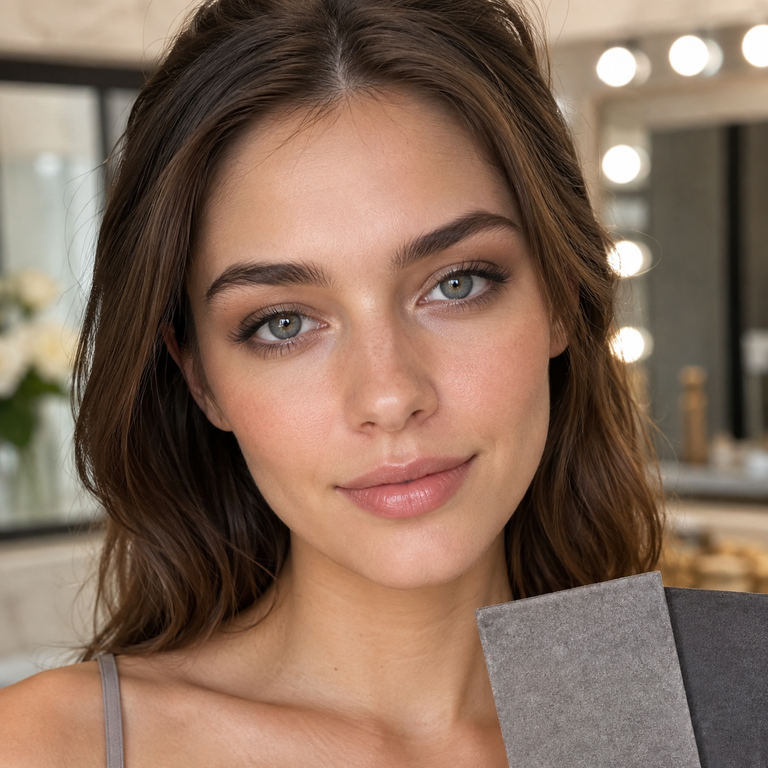
Direct answer: In my catalog comparison, Thai Grey and Olive Grey are technically matched options with different model identities. Thai Grey is model HE1100, while Olive Grey is model HC1419; both listings specify HEMA+NVP material, a 14.2 mm diameter, an 8.6 mm base curve, 38% water content, powers from 0.00 to -4.50, and a listed six-month period after opening. That means I do not choose between them by specifications alone. I start with the exact product identity, compare current official imagery under the same viewing conditions, and then decide which listing better supports the wardrobe, makeup, and photography brief, without assuming that either grey will look a particular way on every eye.
My premium-editor view of Thai Grey vs Olive Grey colored contacts
A premium comparison should make a decision easier without turning a product name into a promise. That principle matters especially with colored contacts. “Thai Grey” and “Olive Grey” are names that help me navigate the Yilala catalog; they are not objective measurements of brightness, undertone, opacity, limbal definition, enlargement, coverage, or the final appearance on an individual eye. The official listings give me a dependable technical core and two distinct model numbers. I keep the rest of the judgment visual, current, and conditional.
From a brand-editor perspective, this is an unusually clean comparison because the specification lines match. I am not balancing a larger diameter against a smaller one, a different water percentage, or a broader prescription range. I am distinguishing HE1100 from HC1419 and deciding which product presentation belongs in a particular creative direction. Readers who want each family’s broader context can open my Thai Series colored contacts guide and Olive Series colored contacts guide before returning to this head-to-head.
My short version is simple: shortlist by verified fit and prescription first, then compare the two official product pages side by side for style. I never reverse that order. A contact lens is a medical device even when the buying goal is fashion, and a catalog match cannot replace a valid contact-lens prescription or professional fitting.
The verified product facts I use
I anchor this grey colored contact lenses comparison in the published product data. The Thai Series product listing identifies Thai Grey as HE1100. The Olive Series product listing identifies Olive Grey as HC1419. Both pages list HEMA+NVP, 14.2 mm diameter, 8.6 mm base curve, 38% water content, 0.00 through -4.50 powers, and six months after opening.
| Comparison point | Thai Grey | Olive Grey | How I use it |
|---|---|---|---|
| Catalog model | HE1100 | HC1419 | I verify the model before ordering or briefing imagery. |
| Material | HEMA+NVP | HEMA+NVP | Matched published specification; not a reason to rank one over the other. |
| Diameter | 14.2 mm | 14.2 mm | Matched published specification; it does not predict fit or visible enlargement by itself. |
| Base curve | 8.6 mm | 8.6 mm | A fit-related number to confirm against the prescription and eye-care guidance. |
| Water content | 38% | 38% | Matched published specification; I do not translate it into a comfort claim. |
| Listed powers | 0.00 to -4.50 | 0.00 to -4.50 | I confirm the exact power required is available; cosmetic zero power still requires a prescription. |
| Listed period after opening | Six months | Six months | An outer replacement limit, never permission to ignore care instructions, damage, symptoms, or professional advice. |
The table explains why I treat this as a design-choice comparison only after clinical suitability has been established. Matching numbers do not mean two designs are visually interchangeable, and they do not guarantee that either is appropriate for a particular wearer. Diameter and base curve are not decorative trivia. Likewise, a listed water percentage is not enough evidence for me to claim that one lens is more comfortable, more breathable, or easier to wear.
The six-month wording also needs disciplined interpretation. I read it as the seller’s listed maximum period after opening, not as a promise that every opened lens remains suitable for that entire time. The prescribed replacement schedule, package instructions, cleaning system, lens condition, and advice from an eye-care professional take priority. If a lens is damaged, contaminated, expired, or associated with symptoms, a calendar does not make it safe.
How I compare two greys without inventing an on-eye result
When I edit a beauty catalog, I separate facts, observations, and predictions. Facts include HE1100 versus HC1419 and the shared specification set. Observations come from the current official product photography, reviewed on the same calibrated screen and at comparable zoom. Predictions concern how a lens may interact with someone’s natural iris, pupil size, lighting, camera processing, and makeup. Predictions are the least reliable layer, so I do not turn them into universal claims.
I open both listings at once rather than relying on memory. Product imagery, stock, and page presentation can change. I compare like with like: similar crop, similar apparent light, and similar screen brightness whenever the available assets allow it. If the images were produced under different conditions, I label the comparison inconclusive instead of treating photographic differences as lens differences. This habit is more useful than asserting that one option is lighter, warmer, cooler, stronger, softer, more opaque, or more defined when the published specifications do not establish those relationships.
I also use the model numbers in notes and shot lists. “Thai Grey, HE1100” and “Olive Grey, HC1419” are precise; “the grey one” is not. That precision protects the whole workflow, from selection to cart review to creative production. It also helps when comparing neighboring catalog choices such as Berry Grey vs Muse Grey colored contacts.
For a shopper, my equivalent process is to save both official URLs, confirm the name and model in the cart, and compare only current brand assets. Screenshots reposted by third parties may be compressed, filtered, relit, or mislabeled. Even an accurate image shows one eye, one lighting setup, one camera pipeline, and one moment. It is reference material, not a guarantee.
My lighting test for a useful visual shortlist
I do not need to claim personal wear to make a rigorous styling decision. I build a lighting board around the context in which the finished look will actually be seen. For daytime editorial, I prioritize neutral window-light references. For evening beauty, I add warm indoor light. For social or ecommerce photography, I check how the planned key light, fill, white balance, exposure, and final color grade affect all greys in the frame.
The important part is consistency. I do not compare Thai Grey under cool, bright light with Olive Grey under dim, warm light and call the result a product conclusion. Instead, I ask which official image is most comparable to the intended set, then keep the uncertainty visible in my notes. If neither listing provides a sufficiently controlled comparison, I keep both on the shortlist until fit, availability, and the rest of the styling brief narrow the choice.
This is also why I avoid an absolute answer to “Which is more natural?” Natural-looking results depend on the relationship among the lens design, natural iris, sclera, pupil, skin, brows, lashes, makeup, light, and camera. My guide to making colored contacts look natural in photos treats photography as a system rather than assigning all responsibility to a shade name.
For mobile content, I add one more checkpoint: I view references at normal feed size. A macro crop can make every detail feel dominant, while a small portrait may compress subtle distinctions. Neither view is the “true” appearance. They answer different creative questions. The full-resolution view helps with retouching and quality control; the feed-size view helps with overall styling balance.
How makeup and wardrobe influence my selection
Because the technical specifications are tied, I let the creative brief do real work. I begin with the wardrobe palette, metal accents, lip family, brow definition, lash weight, and background. Then I compare both current product listings within that mood board. I am not trying to prove that the word “Thai” or “Olive” predicts an undertone. I am checking which documented product identity and available brand imagery make the more coherent editorial story.
For a restrained beauty concept, I reduce competing decisions: clean skin finish, controlled highlight, one deliberate lip direction, and a background that does not cast confusing color onto the eyes. For a more graphic concept, I may allow stronger liner, reflective accessories, or saturated fabric, but I still avoid saying one lens necessarily creates more contrast or definition. Those are outcomes that depend on the wearer and setup, not merely the catalog name.
I also resist the urge to “correct” grey in postproduction. Heavy white-balance shifts, selective iris edits, clarity, sharpening, and saturation can make a comparison useless. My preferred editorial standard is to disclose meaningful retouching, keep eye color edits off the table for comparison images, and use the same grade across both options. A premium presentation earns trust by making the limits of the image clear.
If the larger decision is whether grey belongs in the look at all, I step back to brown vs gray colored contacts. That broader comparison can settle the color-family direction before the team spends time choosing between HE1100 and HC1419.
Grey contacts for brown eyes: what I can and cannot conclude
People searching for grey contacts for brown eyes often want a certain transformation. I cannot responsibly give one from these product specifications. The listings identify the products and their shared physical data, but they do not provide a standardized promise for coverage, opacity, relative brightness, or a specific on-eye color across brown irises. Natural iris depth and pattern, pupil size, ambient light, camera exposure, and display calibration can all influence what a viewer perceives.
My practical recommendation is to use the official imagery as directional reference, never as a personal preview. Review the grey colored contacts for brown eyes guide, confirm the exact prescribed parameters with an eye-care professional, and keep expectations conditional. If a particular degree of color coverage is essential to a shoot, ask the seller for current, product-specific information rather than inferring it from the shade name.
I apply the same restraint to enlargement and limbal-ring language. A 14.2 mm overall diameter does not, by itself, reveal graphic diameter, printed-zone design, or the visible effect on a particular iris. Since the supplied product facts do not establish a difference between these two designs in those areas, I do not rank them there.
Prescription grey beauty contacts: my non-negotiable safety filter
Style comes after professional fit. The FDA’s guidance on decorative contact lenses and risks states that all contact lenses, including decorative lenses, require a prescription. The agency warns that improperly obtained or used decorative lenses can cause harm and lists risks including corneal abrasion, infection, decreased vision, and blindness. A 0.00 cosmetic option is not exempt simply because it does not correct refractive error.
For me, “prescription grey beauty contacts” therefore means more than selecting -1.50 or -3.00 from a menu. A valid contact-lens prescription reflects an eye examination and fitting; a glasses prescription is not an interchangeable shortcut. The listed 8.6 mm base curve and 14.2 mm diameter must match professional guidance rather than a shopper’s guess. My FDA compliance guide explains why the prescription step belongs at the beginning of a legitimate purchase journey.
I pair that with the CDC’s contact-lens prevention guidance: wash and dry hands before handling lenses, keep lenses away from water, use recommended contact-lens solution rather than water, care for the case, follow replacement instructions, and avoid sleeping in lenses unless specifically prescribed. Follow the lens instructions and the eye-care professional’s directions even when they are stricter than a general article.
If there is eye pain, redness, unusual light sensitivity, discharge, swelling, or blurred vision, remove the lenses and contact an eye-care professional promptly. Do not share lenses, buy from a seller that treats the prescription as optional, or use a torn or questionable lens. Safety is not a tie-breaker between Thai Grey and Olive Grey; it is the gate both must pass.
My final selection framework
First, I confirm a current contact-lens prescription and fit. Second, I check whether the required power is within the published 0.00 to -4.50 range and actually available for the selected model. Third, I verify the model number: HE1100 for Thai Grey or HC1419 for Olive Grey. Fourth, I compare the current official imagery under consistent screen and lighting conditions. Fifth, I place each option into the intended wardrobe, makeup, background, and camera plan. Finally, I recheck the cart, package, care instructions, and replacement schedule.
If both remain equally strong after that process, I am comfortable calling the choice a creative preference rather than manufacturing a technical winner. Their published material, diameter, base curve, water percentage, power range, and after-opening period match. The honest differentiator is the specific design identity shown in current official assets, considered within the buyer’s brief and without promising a universal on-eye outcome.
My premium verdict is therefore precise rather than dramatic: Thai Grey HE1100 and Olive Grey HC1419 occupy parallel technical positions in this comparison. Choose only after professional fitting, identify the exact model, and let controlled visual references, not unsupported claims, guide the final style decision.
The safety line behind my grey comparison
I keep the FDA Contact Lens Risks guidance beside the styling notes. Pain, unusual redness, discharge, light sensitivity, or sudden blur means removing the lens and contacting an eye-care professional.
Frequently asked questions
What is the main difference between Thai Grey and Olive Grey?
The verified difference in this comparison is product identity: Thai Grey is HE1100 and Olive Grey is HC1419. Their published material, diameter, base curve, water content, power range, and listed six-month period after opening match. I use current official images for creative selection but do not claim an unlisted relative difference in brightness, undertone, opacity, ring, enlargement, or coverage.
Which is better for brown eyes?
I cannot name a universal winner for brown eyes from the published specifications. A visible result can vary with the natural iris, pupil, light, camera, and display. I would first confirm prescription and fit, then compare current official product imagery as directional reference rather than a certain preview.
Do Thai Grey and Olive Grey have the same lens specifications?
Yes, according to their official listings: both are HEMA+NVP lenses with 14.2 mm diameter, 8.6 mm base curve, 38% water content, powers from 0.00 to -4.50, and a listed six-month period after opening. Matching specifications do not mean identical design or certain fit.
Can I buy either color with vision correction?
Both listings publish a range from 0.00 to -4.50. Confirm that your exact prescribed power is offered and in stock, and buy only with a valid contact-lens prescription. A contact-lens fitting includes more than lens power, so do not substitute a glasses prescription or estimate your parameters.
Does 0.00 power mean I do not need a prescription?
No. In the United States, decorative contact lenses are medical devices and require a prescription even when they provide no vision correction. An eye-care professional needs to evaluate fit and eye health before purchase.
Are these lenses certain to look natural in photos?
No lens can be certain to look natural for every person or photograph. The iris, pupil, styling, light direction, white balance, exposure, lens choice, camera processing, and retouching all affect the image. Use consistent, minimally edited references and treat product photography as guidance.
Can I wear an opened pair for six months?
The product pages list six months after opening, but that is not a guarantee for every lens or wearer. Follow the prescribed replacement schedule, package instructions, care rules, and professional advice. Discard a damaged, contaminated, expired, or symptom-associated lens regardless of elapsed time.
How do I choose between HE1100 and HC1419?
Verify professional fit and prescription first. Then compare current official images of HE1100 and HC1419 under consistent viewing conditions, place each into the same makeup and wardrobe plan, and confirm the exact model in the cart. If both suit the brief, the final choice can honestly remain a style preference.