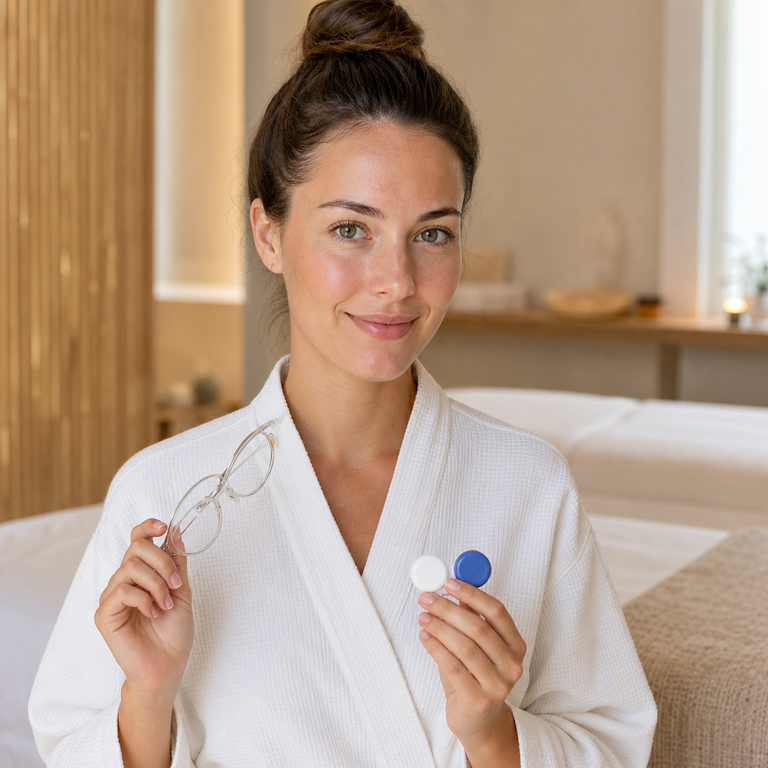
You are already in the treatment room, your hair is tucked into a wrap, and the esthetician asks whether you wear contact lenses. It can feel like a minor detail, especially if your colored contacts are prescription-free in power. It is not a reason to panic or cancel. It is simply the right moment to pause and find out what the facial will involve.
Ask the provider, but removing colored contacts beforehand and using glasses before and after the appointment is the lower-risk choice when a facial includes steam, water, eye-area products, a mask, massage near the eyes, or keeping your eyes closed for a long time. A brief basic facial that stays well away from the eyes does not automatically damage a lens. The practical decision depends on the treatment steps, your lens-wearing plan, and whether you can remove and reinsert the lenses with properly washed and dried hands.
Colored contacts are still contact lenses and medical devices, even when worn only for appearance. The goal is not to make every salon visit sound hazardous. It is to avoid predictable problems such as product splashes, water exposure, rubbing, trapped residue, and hurried lens handling in an unsuitable space.
Start with the actual facial, not the service name
“Facial” can mean a short cleanse and moisturizer, or a long appointment with hot towels, steam, exfoliation, masks, facial oils, eye cream, massage, and lash or brow work. A booking title rarely tells you enough. Message the spa or ask at check-in: Will there be steam? Will water or cleanser be used around my eyes? Is an eye mask or eye-area massage included? Are lash or brow services part of the appointment?
That conversation lets the provider adapt the service or tell you when they need your lenses out. It also prevents an awkward mid-treatment decision after your face and hands already have product on them.
| Treatment stage | What changes the lens decision | Lower-risk plan |
|---|---|---|
| Basic cleanse and facial products kept away from the eyes | Less direct exposure, but accidental splash or migration is still possible | Ask the provider; glasses remain the simpler option if you do not need lenses |
| Facial steam, hot towels, rinsing, or mist | Water, heat, and prolonged closed-eye time add avoidable uncertainty | Remove lenses before the appointment and keep them away from water |
| Eye mask, eye cream, eye-area massage, or eye makeup removal | Products and pressure are being applied close to the lids and lashes | Arrive without lenses unless your eye-care professional and provider give a different plan |
| Lash lift, tint, extensions, brow tint, or waxing add-on | Adhesives, dyes, shields, fumes, cleansing, or close manipulation may be involved | Tell the technician about lenses and follow the service-specific pre-appointment instructions |
| After the facial | Residue may remain on fingers, lashes, lids, or around the sink | Use glasses until your hands are clean and dry and your eyes feel normal |
Why steam and water deserve their own answer
Steam is not the same thing as swimming or putting a lens under a faucet, and a steamy room does not guarantee that something will go wrong. Still, facial steam often comes with mist, condensation, hot towels, rinsing, and closed eyes. Those combined conditions make lens-free treatment easier to control. Our guide to colored contacts in saunas and steam rooms explains the broader steam question, while the showering guide covers direct water exposure.
The CDC advises contact lens wearers to avoid sleeping in lenses unless directed by an eye-care provider, keep lenses away from water, wash and dry hands before touching them, and follow recommended replacement and care schedules in its contact lens prevention guidance. During a facial, “keep lenses away from water” is the useful part of that advice. Do not assume that closing your eyes creates a watertight seal.
If the facial is genuinely dry, brief, and far from the eye area, the provider may be comfortable proceeding while you wear lenses. That is different from saying every lens wearer must remove them for every basic facial. When the service includes steam or water, however, glasses and a clean lens case remove several avoidable variables at once.
Eye-area treatments change the calculation
An eye mask or eye cream may be applied outside the eye, but products can move with warmth, massage, tears, or blinking. Massage can also press on the closed lid. Even if a lens remains centered, you do not want to rub an eye reflexively while cleanser, oil, exfoliant, or treatment product is on your fingers.
The FDA’s Eye Cosmetic Safety guidance says to keep cosmetic containers clean, wash hands before applying eye cosmetics, avoid eye cosmetics when the eye or surrounding skin is inflamed, and stop using a product that causes irritation. A facial product is not necessarily an eye cosmetic, which is precisely why products not intended for the eye should not be treated as lens-compatible.
Keeping your eyes closed for a long appointment is not automatically harmful to every contact lens. The issue is practical: you may notice early blur, dryness, stinging, or lens movement less clearly while reclined, covered by a mask, and expected to stay still. Removing the lenses in advance makes it easier to relax without monitoring them.
Lash and brow add-ons are separate services
A lash lift, lash tint, eyelash extensions, brow tint, lamination, or waxing appointment should not be folded casually into the answer for a basic facial. These services can involve adhesives, dyes, shields, tapes, solvents, close work along the lid margin, or instructions that vary by provider and product.
Tell the technician that you wear colored contacts when booking, not after the service starts. Follow their pre-service instructions and your eye-care professional’s advice. For extension-specific preparation and aftercare, read our guide to colored contacts and eyelash extensions. If eye makeup is also involved, the colored contacts makeup guide helps sequence lenses and cosmetics without implying that makeup products are safe inside the eye.
Rescheduling may be appropriate if the eyelids or surrounding skin are red, swollen, painful, or irritated. Do not use a colored lens to push through symptoms for an event or photo. A fresh look is not worth obscuring a developing eye problem.
Remove lenses cleanly before the appointment
The cleanest plan begins at home. Wash your hands with soap and water, rinse thoroughly, and dry them with a clean lint-free towel before touching a lens. Remove the lenses before applying skin care, sunscreen, foundation, or hair products that might transfer from your fingers. If the lenses are reusable, place them in a clean case with fresh recommended disinfecting solution according to the lens and solution instructions. Never top off old solution.
If you wear daily disposables, discard the pair after removal rather than storing it for later reuse. Bring glasses in a protective case. If you may reinsert lenses later, pack an unopened replacement pair when your prescription and wearing schedule allow it, plus the appropriate supplies. Do not improvise with water, saliva, eye drops not intended for lens care, or a decorative container.
Our step-by-step guide to handling colored contacts without contamination covers a portable routine. The FDA also emphasizes that decorative lenses require a prescription and proper fit, and that wearers should follow cleaning, disinfecting, and wearing directions in its decorative contact lens guidance.
Do not plan to remove lenses in the spa bathroom after treatment has begun. Your hands may carry oils, masks, exfoliants, fragrance, disinfectant residue, or lint. The counter may be wet and the mirror poorly lit. If you unexpectedly need to remove a lens, ask the provider to stop, then find a clean, well-lit place where you can wash and fully dry your hands. If that setup is not available, seek the safest practical help rather than digging at the lens.
If cleanser, mist, or another product splashes your eye
Speak up immediately. Do not keep your eyes squeezed shut and wait for the appointment to end. Stop the treatment and avoid rubbing. Follow the product label’s eye-exposure directions; for many accidental cosmetic splashes, that means prompt rinsing with clean water. A contact lens exposed to the splash should be removed as soon as you can do so safely with clean, dry hands, but urgent rinsing should not be delayed while you search for a case.
Do not put the same lens straight back in. If it is a daily disposable, discard it. For a reusable lens, follow the manufacturer’s and your eye-care professional’s cleaning and disinfection instructions, and replace it if you cannot confirm that it can be safely reused. Contact lens solution is not a substitute for flushing an exposed eye unless a clinician or the product instructions specifically direct its use that way.
If the splash involved a peel, acid, adhesive, dye, solvent, or another concentrated treatment, tell the provider exactly what entered the eye and get the product name or ingredient list. Contact Poison Control in the United States at 1-800-222-1222 or seek urgent medical guidance as appropriate. Severe pain, vision change, marked redness, light sensitivity, discharge, swelling, or symptoms that persist after rinsing need prompt professional evaluation.
Red flags are not normal facial aftereffects
Mildly relaxed or warm skin after a facial is one thing. Eye pain or reduced vision is another. The FDA’s Contact Lens Risks page notes that contact lens complications can develop quickly and advises wearers to remove lenses and contact an eye-care professional when they experience irritation, pain, discomfort, excess tearing, unusual discharge, light sensitivity, itching, burning, grittiness, unusual redness, blurred vision, swelling, or an infection.
Do not reinsert a lens to test whether the eye is “fine now.” Leave lenses out and use glasses. If symptoms are significant, worsening, one-sided, or accompanied by a vision change, seek urgent eye care. Keep the lens, packaging, and names of products used only if a clinician asks for them; do not delay care to collect evidence.
A lens that feels stuck should not be forced off with fingernails. Lubrication and removal advice depends on the lens and the situation. Call an eye-care professional if normal, clean removal is not working, particularly when pain, redness, trauma, or chemical exposure is involved.
When can you put colored contacts back in?
There is no universal timer such as 30 minutes after every facial. Restart when the exposure is over, your eyes and eyelids feel normal, your vision is clear, and you can wash and dry your hands without transferring facial products. Make sure there is no oily film, cleanser, lash adhesive, tint, or mask residue around your fingers or lid margins. If eye makeup needs to be removed first, follow a clean sequence such as the one in our guide to removing eye makeup with colored contacts.
Glasses for the rest of the day are sensible after steam, an eye-area service, a splash, or any irritation. Follow stricter aftercare instructions from the facial provider, lash or brow technician, product label, or your eye-care professional. If medicated drops or a procedure were involved, ask the prescribing clinician when lens wear can resume.
Use a fresh pair when your replacement schedule calls for it. Do not extend a daily disposable or reuse a lens that contacted water or an unknown product simply because it still looks clear. A lens can carry residue without displaying an obvious stain.
Prescription and fit still matter on spa day
Colored contacts that do not correct vision are not exempt from prescription and fitting requirements in the United States. An eye-care professional evaluates the eye and determines lens measurements and a suitable product. The FDA warns that an incorrect fit can damage the eye, and its decorative lens guidance lists possible harms including corneal abrasion, allergic reactions, decreased vision, infection, and blindness.
Buy from a seller that requires and verifies a valid prescription, use the exact prescribed brand and parameters, and follow the given wear and replacement schedule. Our FDA compliance overview explains Yilala’s approach, but it does not replace an examination or individualized clinical advice.
If you are browsing color after confirming your prescription, the Olive Series is one restrained style option. That product link is not a claim that the lens is suitable for a facial, steam, eye-area treatment, or extended closed-eye wear. Treatment-day handling still depends on the service, the prescribed lens, and professional instructions.
A simple appointment plan
Contact the provider before the appointment and describe your lenses as contact lenses, not merely an accessory. Ask for the treatment steps. If steam, water, eye products, masks, massage, or lash and brow add-ons are included, remove the lenses cleanly at home and wear glasses. Bring your lens supplies only if you have a clean, realistic reason to reinsert them later.
During the service, report any splash, sting, sudden tearing, blur, or pain immediately. Afterward, keep lenses out until your hands, lids, and lashes are free of residue and your eyes feel completely normal. When in doubt, glasses are a low-effort way to avoid turning a relaxing appointment into rushed lens care.
Frequently asked questions
Can I wear colored contacts during a basic facial?
Possibly, if the treatment is brief, dry, and stays away from the eye area, but ask the provider first. Removing the lenses and wearing glasses is still the simpler lower-risk plan when you do not need them during the service.
Should I remove colored contacts before facial steam?
Yes, removing them beforehand is the prudent choice. Facial steam often comes with mist, condensation, rinsing, or hot towels, and contact lenses should be kept away from water.
Can I keep my eyes closed over colored contacts during a mask?
Closed eyes do not guarantee that water or product cannot reach the lids and lashes. If the mask sits near the eyes or stays on for a long time, arrive lens-free unless your providers advise otherwise.
What if a facial product gets in my eye while I am wearing contacts?
Stop the service, do not rub, and follow the product’s eye-exposure directions, including prompt rinsing when directed. Remove the lens safely with clean, dry hands, do not immediately reinsert it, and seek help for persistent or severe symptoms.
Can I remove my lenses in the spa bathroom?
Avoid it when possible, especially after products have been applied to your hands or face. Remove lenses at home; if removal becomes necessary, use a clean, well-lit space and wash and fully dry your hands first.
How long after a facial should I wait to wear colored contacts?
There is no single waiting period. Resume only when your eyes feel normal, vision is clear, residue is gone, and clean, dry handling is possible; use glasses longer after a splash, irritation, steam, or eye-area service.
Do non-prescription colored contacts need a prescription for a facial?
Yes. In the United States, decorative colored contacts are medical devices and require a prescription even if they have no vision-correcting power. A facial does not change that requirement.
Can I wear colored contacts for a lash or brow add-on?
Do not assume the rule for a basic facial applies. Ask the lash or brow technician in advance, disclose lens wear, and follow the service-specific preparation and aftercare instructions.
Official sources
- U.S. Food and Drug Administration: Eye Cosmetic Safety
- U.S. Food and Drug Administration: Decorative Contact Lenses for Halloween and More
- U.S. Food and Drug Administration: Contact Lens Risks
- Centers for Disease Control and Prevention: Preventing Eye Infections When Wearing Contacts
This article provides general educational information and is not a diagnosis or a substitute for advice from your eye-care professional or treatment provider.