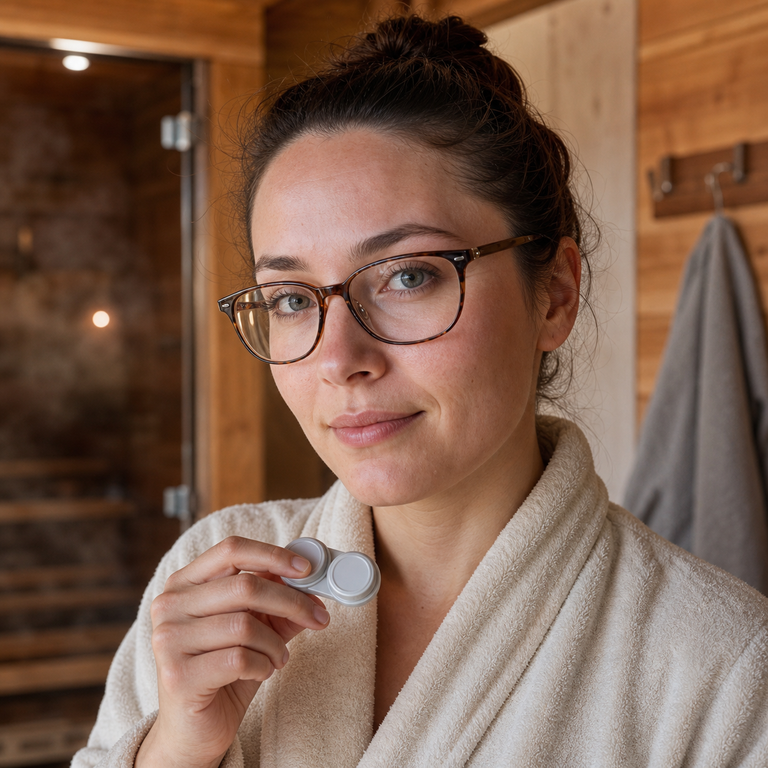
The locker-room door swings open, the tile is damp, and a cloud of steam rolls past the bench where you are deciding whether to leave your colored contacts in. Your sauna reservation starts in two minutes; a shower and cold plunge may come next. The direct answer is simple: the safest practical choice is to remove colored and clear contact lenses before a sauna or steam room, especially when showers, splashing, wet hands, condensation, or a plunge pool are part of the visit.
In the United States, colored contacts are medical devices, not ordinary fashion accessories. They require a valid prescription and proper fitting, even when they have no vision-correcting power. The FDA’s decorative contact lens guidance explains that all contact lenses require a prescription and that incorrect use or a poor fit can harm the eye. There is no specific US federal rule that names saunas or steam rooms as a prohibited setting. Still, the broader federal health guidance about contact lenses, water, handling, and symptoms applies to what happens during a spa or gym visit.
Sauna, Steam Room, Shower, and Plunge Pool Are Not the Same Exposure
It helps to separate the settings instead of treating the whole wellness area as one hot room. A traditional dry sauna mainly exposes you to hot air and sweat. A steam room surrounds you with high humidity and suspended water droplets that collect as condensation. A shower puts flowing tap water close to the eyes. A hot tub or plunge pool can immerse or splash the face with water from a shared recreational system.
That distinction changes the practical concern. It is inaccurate to say that the heat of a dry sauna melts a properly worn soft contact lens. Contact lenses sit on the tear film, and ordinary sauna use is not usefully explained by a dramatic “melting lens” claim. The more realistic issues are discomfort, sweat around the eyes, evaporation at the eye’s surface, accidental rubbing, and what you do with wet hands afterward.
Steam deserves more caution than its airy appearance suggests. Steam is water in vapor form, and it condenses on skin, eyelashes, benches, and hands. The CDC’s contact lens infection-prevention guidance tells wearers to keep contacts away from all water and remove them before swimming or showering to reduce germ exposure. The page does not single out steam rooms, but its water-avoidance principle supports taking lenses out before entering one.
| Environment | Main lens concern | Practical action |
|---|---|---|
| Dry sauna | Heat, sweat, surface evaporation, and eye rubbing may increase discomfort | Remove lenses before entry; use glasses outside the hot room |
| Steam room | Water vapor condenses, while hands and surfaces may be wet | Remove lenses before entry and keep the case outside the wet area |
| Shower | Tap water can reach the lens directly | Remove before showering; never rinse lenses or a case with tap water |
| Hot tub or plunge pool | Splashing or immersion can expose lenses to water | Do not wear lenses in the water; use suitable swim eye protection if needed after professional guidance |
Why Water Is the Clearest Reason to Remove Contacts
A contact lens can trap material against the eye and can be harder to handle safely once your hands, face, or storage supplies are wet. Water is not a substitute for sterile contact lens solution. That includes tap water, bottled water, pool water, hot-tub water, and condensation collected on your fingers. Even water that looks clean is not prepared or labeled for disinfecting contact lenses.
This is why a spa visit can become riskier during transitions. You might leave a dry sauna, wipe sweat from your eyelid, step into a shower, then adjust a lens with damp fingers. Or you may enter a steam room intending to keep your face away from droplets, only to rub your eye after touching a wet door handle. Removing the lenses beforehand avoids that chain of improvised handling.
If the shower is the part you are most unsure about, read Yilala’s detailed guide to showering in colored contacts. For pools and other immersion settings, the guide to swimming with colored contacts explains why water exposure deserves its own plan. A sauna visit that includes either activity should be organized around the wettest part of the itinerary, not the driest.
What Heat, Sweat, and Humidity May Do
Heat and humidity do not affect every wearer in the same way. A person’s tear film, lens material, fit, wear time, medications, and surrounding airflow can all influence how the eyes feel. There is no responsible universal temperature or minute limit that makes wearing colored contacts in a sauna acceptable for everyone. Facility temperatures also vary, and the experience of a short seated visit is not a clinical test of lens compatibility.
In a dry sauna, warm air and evaporation may make the lens feel more noticeable. Sweat can run toward the eyelids, and the natural reaction is often to wipe or rub. Rubbing through a lens can shift it or irritate the eye. None of this means that every contact lens wearer will develop dry eye, but discomfort is a useful signal to stop rather than a challenge to push through.
A steam room feels moist, yet moist air does not make contact lens wear hygienic. Condensation is still water exposure, and high humidity does not disinfect hands, lenses, or cases. Sweat and skin products may also migrate toward the eye. If your lenses already feel scratchy before entering, the steam room is not a treatment.
The National Eye Institute’s dry eye overview notes that dry eye can cause stinging, burning, a scratchy feeling, redness, light sensitivity, and blurry vision. Those symptoms have more than one possible cause. If they persist or are significant, an eye-care professional should assess them rather than having you self-diagnose the problem as simple sauna dryness. Yilala’s article on why colored contacts can feel dry offers additional everyday context without turning a symptom into a diagnosis.
A Low-Friction Plan for Spa and Gym Days
The easiest routine starts before you reach the locker room. Arrive in glasses. If you need contacts earlier in the day, bring your current prescription glasses, the supplies specified for your prescribed lens type, and a clean place to remove the lenses before entering any hot or wet zone. Do not rely on finding a dry counter beside a sink.
- Remove lenses before entry. Wash your hands with soap and water, then dry them completely with a clean, lint-free towel. Remove the lenses in a clean area away from splashing sinks.
- Store only as directed for that lens type. Reusable lenses should go into a clean case with fresh contact lens disinfecting solution recommended for them. Never “top off” old solution. Daily disposables are removed and discarded, not stored for later wear.
- Keep supplies out of the wet zone. Leave the case, solution bottle, and glasses in a clean, dry locker location. A case sitting on a steamy counter can become wet on the outside and awkward to handle.
- Finish the water activities before considering lenses again. Sauna, steam room, shower, pool, and plunge should all be over. Your hands and face should be clean and fully dry.
- Follow your prescription and replacement schedule. If you are uncertain whether a reusable lens can be worn again after the day’s handling, ask your eye-care professional instead of improvising.
Good handling matters beyond the spa. Review this step-by-step guide to handling colored contacts without contamination. It reinforces a habit that is easy to skip when you are tired, rushed, or working with a small locker-room mirror: clean, fully dry hands come before touching a lens.
What to Do After Unexpected Water Exposure
Plans slip. A shower sprays your face before you remember the lenses, someone splashes near the plunge pool, or you adjust a contact after touching condensation. Do not panic, and do not treat a lens as clean merely because it still feels normal.
Move to a clean, dry area and follow the care instructions from your eye-care professional and the manufacturer for your prescribed lens type. Wash and fully dry your hands before touching your eyes. Remove the lenses. Never rinse a lens with tap water, and never use tap water to rinse the storage case.
A daily disposable that has been exposed to water should not be reinserted. Discard it and use glasses. For reusable lenses, the correct next step depends on the lens and prescribed care system. Follow your eye-care professional’s guidance for cleaning, disinfecting, storage, and whether the lens should be discarded. Do not guess at a shortened soak time or use homemade saline.
Pay attention to how your eyes look and feel. The FDA’s contact lens risk guidance lists warning symptoms that include discomfort, unusual redness, discharge, unusual sensitivity to light, blurred vision, swelling, and pain. Remove the lenses and contact an eye-care professional promptly if redness, pain, discharge, light sensitivity, or blurred vision appears, especially if a symptom persists or worsens. Do not reinsert lenses to test whether the eye has “settled down.”
Colored Contacts Need the Same Medical-Device Discipline
A cosmetic tint does not change the basic responsibilities of contact lens wear. US law treats decorative lenses as medical devices. An eye exam, prescription, and professional fitting help determine whether a lens design and size are appropriate for your eyes. A prescription also gives you a defined brand or lens specification and a replacement schedule, rather than leaving you to choose by appearance alone.
Buy only from a seller that requires a prescription, and follow the wearing and care instructions you were given. Never share colored lenses, even for a photo. Do not sleep in them unless your eye-care professional has specifically prescribed that use. Yilala’s FDA compliance information provides brand-specific purchasing context, while the FDA pages remain the official source for US regulatory and safety guidance.
Once prescription, fit, and care are settled, color is an aesthetic choice for appropriate dry settings. If an olive tone suits your planned look, you can view Yilala’s Olive Series colored contact lenses. Product selection does not change the remove-before-sauna, steam room, shower, and pool routine.
For warm-weather schedules that combine air conditioning, outdoor time, travel, and water activities, see colored contacts for summer. The useful question is not whether a lens matches the season. It is whether you can keep that lens within its prescribed wear, replacement, and hygiene routine throughout the day.
When Glasses Are the Simpler Choice
Glasses remove the need to handle lenses in a humid locker room. Wear them to the facility, store them in a protective case before entering the hot room, and put them back on after you have cooled down and dried your face. Frames can become hot or fogged, so they should not be worn inside a sauna unless the facility and frame manufacturer say the materials are suitable. The point is to use glasses outside the hot and wet areas as your reliable vision backup.
If you cannot see well enough to move safely without correction, plan the route before removing your contacts. Ask facility staff about lockers, handrails, lighting, and whether prescription swim goggles are appropriate for a pool area. Do not trade eye hygiene for navigation. A companion or an accessible facility setup may make the visit easier.
You may also decide that wearing contacts earlier in the day and switching to glasses for the spa is less cumbersome than trying to reinsert lenses afterward. A clean pair of glasses is often the practical end point, especially after a late workout when careful lens handling is unlikely to get your full attention.
FAQ
Can dry sauna heat melt colored contact lenses?
There is no sound reason to claim that ordinary dry sauna heat melts a properly worn contact lens on the eye. The practical concerns are possible discomfort, sweat, evaporation, rubbing, and the wet activities that often accompany a sauna visit. Removing lenses before entry avoids those problems without relying on a temperature cutoff.
Is a steam room safer for contacts because the air is humid?
No. Humid air may feel different from dry heat, but steam is water and condenses on your face, lashes, hands, and nearby surfaces. CDC guidance says to keep contacts away from all water. Remove them before entering rather than treating humidity as protective.
Can I keep contacts in if I skip the shower and pool?
Skipping direct water exposure removes one concern, but it does not eliminate sweat, rubbing, handling, or discomfort in a hot room. There is also no federal time or temperature threshold that makes sauna contact wear suitable for every person. The safest practical choice remains removal before entry.
Can I rinse my lenses after the sauna with tap water?
No. Tap water is not contact lens solution and should not be used to rinse lenses or their case. Use only the care products and process prescribed for your reusable lens type. Discard daily disposables after removal.
What if shower water touched my daily disposable contacts?
Wash and fully dry your hands, remove the lenses, and discard them. Do not reinsert a daily disposable after water exposure. Put on glasses, monitor your eyes, and contact an eye-care professional if redness, pain, discharge, light sensitivity, or blurred vision develops.
Can I reinsert reusable colored contacts after a steam room?
Only if the lenses were removed beforehand, stored correctly in fresh prescribed disinfecting solution, and remain within their approved schedule. If they were exposed to water or handled with wet hands, follow your eye-care professional’s instructions about disinfection or disposal before considering wear again.
Are prescription colored contacts exempt from the water rule?
No. A prescription and fitting are required, but they do not make a lens suitable for water exposure. The CDC’s advice to keep contacts away from all water applies to contact lenses generally, including colored lenses with or without vision correction.
When should I call an eye-care professional after a spa visit?
Remove the lenses and seek prompt professional guidance for redness, pain, discharge, unusual light sensitivity, or blurred vision, particularly when symptoms persist or worsen. The FDA cautions that wearers cannot judge the seriousness of a contact-lens problem on their own.