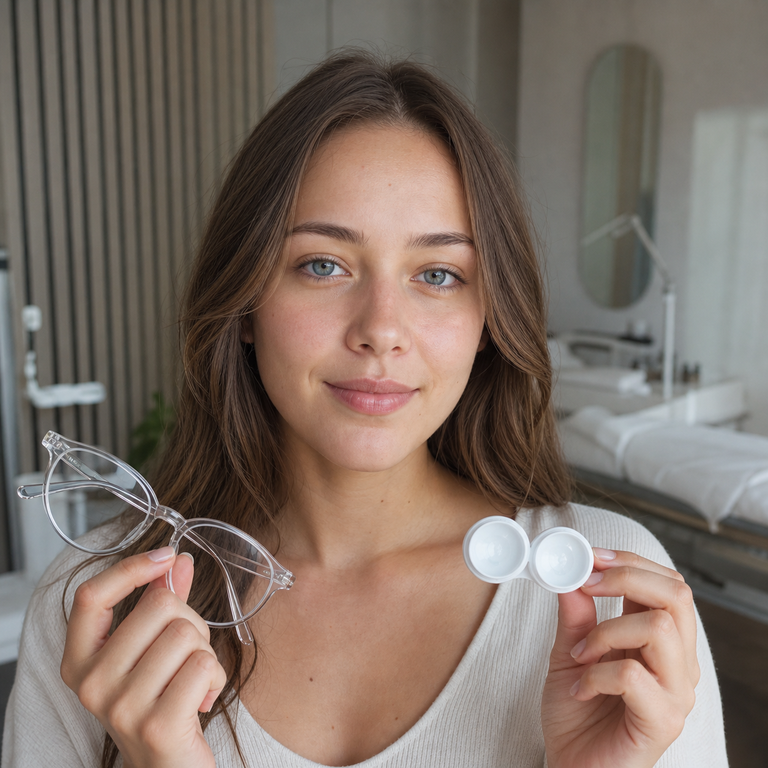
You have a lash lift booked, your colored contacts are already in, and the appointment is supposed to be an easy hour with your eyes closed. The lenses may feel unrelated to the service. They are not part of the lashes, but they do sit on the eye directly below the area being treated.
Ask your lash technician about their policy, but removing colored or clear contacts before a lash lift is the lower-risk choice. Your eyes stay closed while silicone shields or pads and chemical solutions are used close to the lid margin. Taking lenses out removes one variable if your eyes water, product migrates, or you need to rinse promptly. Wear glasses to the appointment and plan to use them afterward.
This does not mean every lash lift harms the eyes, or that everyone needs the same number of contact-free hours afterward. There is no universal restart time that fits every product, technique, eye, or reaction. Follow the technician’s aftercare directions and any advice from your optometrist or ophthalmologist. If the two differ, choose the more cautious instruction.
Why contacts matter and how lash services differ
A lash lift reshapes the natural upper lashes. A technician usually places a curved silicone shield on the upper lid, adheres the lashes to it, and applies lifting and setting solutions in controlled areas. Depending on the service, a tint or conditioning step may follow. Your eyes remain closed because tools, adhesives, pads, and chemical products are being handled close to the eyelid.
A contact lens covers the cornea. It does not protect the eye from lash-lift solution, adhesive, cleanser, tint, or rinse water. If anything reaches the eye, a lens can complicate the moment: you may need to open an already irritated eye, remove the lens without contaminating it, and start rinsing. The practical benefit of arriving lens-free is simple. The technician can focus on the lashes, while you are ready to rinse without first dealing with a lens.
The FDA’s eye cosmetic safety guidance advises keeping eye cosmetics clean, stopping use if irritation occurs, and avoiding eye cosmetics when the eye or surrounding skin is inflamed. A lash lift is a professional salon service rather than ordinary daily makeup, but the same basic caution makes sense when cosmetic products are used near the eye.
Tell the technician before the appointment if you wear contacts, have dry or sensitive eyes, recently had an eye infection or procedure, use medicated eye drops, or have reacted to lash products before. A conscientious technician may adjust preparation, decline the service, or ask for medical clearance. That is a screening decision, not an inconvenience.
Colored and clear contact lenses belong in the same decision here. Both rest on the eye, both require clean handling, and both can be uncomfortable if tears or contaminants get trapped around them. A cosmetic tint does not make a colored lens a protective beauty accessory. The FDA explains that decorative contacts are medical devices and should be obtained with a prescription, even when they do not correct vision.
A lash lift is also different from eyelash extensions. A lift works with your natural lashes and uses lifting and setting products. Extensions attach fibers to individual natural lashes with adhesive. The contact-lens question overlaps because both services happen close to closed eyes, but the products, timing, and aftercare are not identical. Use the separate guide to colored contacts and eyelash extensions when extensions are the service on your calendar.
Mascara is different again. It is a removable coating applied to lashes, usually by the wearer, and it should not be confused with the chemical reshaping step in a lift. Many technicians want lashes free of mascara, liner, oil, and makeup remover residue before a lift. Our colored contacts makeup guide covers everyday sequencing, while the appointment policy still comes from your technician.
Do not assume a routine that worked for mascara or extensions automatically applies to a lift. Ask what will touch the lid, whether tint is included, how the technician handles an accidental splash, and whether contacts must be removed before you arrive. Specific questions produce a more useful answer than asking only whether contacts are “allowed.”
A practical plan for each appointment stage
The easiest plan is to decide before leaving home, not while lying on the treatment bed. Bring glasses that let you travel, read forms, and get home without putting lenses back in on a timetable your eyes may not accept.
| Appointment stage | Lower-risk contact-lens plan | What to notice or ask |
|---|---|---|
| Before leaving home | Wash and dry hands, remove lenses cleanly, and switch to glasses. | Are the eyes white, comfortable, and free of discharge or unusual watering? |
| At check-in | Tell the technician you wear colored contacts and that they are out. | Confirm the service steps, products, tint, patch-test policy, and splash procedure. |
| During the lift | Keep eyes gently closed and do not squeeze the lids unless instructed. | Report burning, stinging, sharp discomfort, or solution movement immediately. |
| Right after | Use glasses. Do not rush to reinsert lenses in the salon or restroom. | Check for persistent redness, pain, light sensitivity, blur, swelling, or discharge. |
| Later that day | Restart only if the eyes are normal and your professional guidance permits it. | If symptoms remain, keep lenses out and contact an eye-care professional. |
This table is a planning tool, not a medical clearance or a salon protocol. A technician may require a contact-free appointment even when your eyes feel fine. An eye-care provider may advise a longer break because of your own history, medication, or symptoms. Follow the person who can evaluate the relevant risk.
Remove contacts cleanly before the appointment
Removing lenses only helps if the removal itself is clean. Wash your hands with soap and water, then dry them fully with a clean, lint-free towel before touching the lens or eye. The CDC’s contact lens prevention guidance centers hand hygiene, proper cleaning, fresh solution, and keeping lenses away from water.
Take the lens out over a clean, dry surface. If it is reusable, rub and rinse it only as directed with the recommended disinfecting solution, then place it in a clean case with fresh solution. Do not top off old solution. Do not use tap water, bottled water, saliva, or a wet tissue as a substitute. If it is a daily disposable, discard it rather than saving it for later reinsertion.
Timing matters less than cleanliness and comfort. Remove lenses at home if possible, where you have soap, a clean towel, proper solution, a case, and good lighting. Taking them out in a parked car or salon waiting area encourages shortcuts. The detailed guide to handling colored contacts without contamination explains a repeatable clean-hand routine.
Makeup-contaminated hands are a common appointment problem. Do not remove lenses after applying mascara, liner, concealer, lash serum, hair product, fragrance, or setting spray unless you wash and dry your hands again. Oils, pigment, remover, lotion, and loose fibers can transfer from fingers to the lens or eye. If you need to remove eye makeup, take the lenses out first and follow this lens-aware eye makeup removal sequence.
Prepare the eye area without overdoing it
Arrive with clean lashes and follow the technician’s exact prep instructions. Usually that means no mascara, strip-lash glue, oily remover, heavy eye cream, or lash curler on the day of service. Do not add a new eye product the night before just because it claims to clean, prime, calm, or strengthen lashes. A new product introduces another possible irritant at the worst time for troubleshooting.
Do not hide active symptoms under makeup. Redness, crusting, swelling, discharge, a painful bump, unusual watering, or a scratchy sensation is a reason to contact the technician before the appointment. They may postpone. If you suspect infection, injury, or a reaction, ask an eye-care professional rather than trying to make the lid look presentable for the service.
If the technician offers a skin patch test, understand its limit. A skin test may help identify some skin sensitivities to a product, but it cannot guarantee that the ocular surface will tolerate an accidental exposure. It also does not make contact lenses protective. Ask how the salon keeps solutions away from the lid margin and what they do if you report stinging.
Pack glasses, a clean case if you use reusable lenses, and the lens solution recommended for your lens system. Avoid carrying an unlabeled travel pot filled from a larger bottle. Leave enough time that you will not be tempted to handle lenses with rushed, product-coated hands. For other treatments around the face, the decision points in wearing colored contacts during a facial can help you separate eye-area exposure from a routine skincare appointment.
If solution splashes or the eyes react
Burning, significant stinging, a feeling that liquid entered the eye, or sudden watering is not something to tolerate quietly for the sake of the result. Tell the technician immediately. The service should pause so the eye can be assessed and the product’s first-aid instructions can be followed. Do not let anyone continue while telling yourself that discomfort is simply part of a lift.
If you ignored the lens-free plan and are wearing contacts, remove them as soon as you can do so without causing additional injury, then follow the product label or Safety Data Sheet instructions for rinsing. If removal is difficult, the lens seems stuck, or pain is severe, seek urgent professional help rather than repeatedly pinching or rubbing the eye. Bring the product name or ingredient information when possible.
Do not try to neutralize one salon chemical with another. Do not place contact solution, homemade saline, oil, makeup remover, or random eye drops into an exposed eye unless the product instructions or a qualified clinician directs it. Rubbing can add mechanical irritation. An approved lubricating drop may be useful for ordinary contact-lens dryness, but it is not a chemical-exposure treatment. The guide to eye drops for colored contacts explains why bottle labeling and lens compatibility matter.
The FDA’s contact lens risk guidance says to remove lenses and contact an eye-care professional when irritation occurs. A suspected chemical exposure deserves more caution, not less. In the United States, Poison Control can provide product-specific guidance at 1-800-222-1222, while severe symptoms warrant urgent medical care.
When can you wear colored contacts again, and what are the red flags?
There is no universal waiting period after a lash lift. The correct restart point depends on whether product reached the eye, whether you had symptoms, what aftercare the salon gave, and what your eye-care provider recommends. A fixed rule such as “wait exactly two hours” or “always wait a full day” sounds convenient but may be wrong for the service and the person.
At minimum, wait until your eyes feel completely normal: no burning, gritty feeling, unusual dryness, persistent tearing, redness, light sensitivity, discharge, swelling, pain, or changed vision. The National Eye Institute’s dry eye overview lists scratchiness, redness, light sensitivity, and blurry vision among symptoms that deserve attention, although those symptoms do not identify the cause after a salon service. The lids should also be comfortable enough that inserting a lens will not require pulling on tender or irritated skin. If the salon gave a longer contact-free instruction, use the longer interval.
Restart with clean, dry hands in a clean place. A fresh daily disposable removes the question of whether the earlier lens was exposed to makeup, cleanser, solution, or rinse water. For reusable lenses, only use a properly disinfected lens that has completed the full care-system cycle. Never reinsert a lens that was in the eye during a splash or that touched salon products.
Once inserted, pay attention to the first few minutes rather than pushing through discomfort. If the lens stings, feels scratchy, causes excess tearing, or makes vision less clear, remove it. Return to glasses and contact your eye-care provider if symptoms do not settle. Do not keep trying different lenses to test whether the problem is the lens or the eye.
Get prompt eye-care advice for pain, persistent redness, discharge, notable swelling, a foreign-body sensation that does not resolve, or symptoms that worsen instead of improving. Seek urgent evaluation for light sensitivity, sudden or continuing blurred vision, reduced vision, severe pain, trouble opening the eye, a visible corneal spot, or suspected chemical injury. Keep contacts out until an eye-care professional says it is appropriate to resume.
Do not treat a red eye after a salon service as a photo problem. Filters, concealer, redness-relief drops, and a second beauty appointment can hide or aggravate the issue without addressing its cause. Record when symptoms began, what products were used, whether contacts were in, and what rinsing or drops you tried. That information can help a clinician assess the exposure.
For a later, symptom-free day, a subtle lens color may complement lifted lashes without mascara. Yilala’s Olive Series colored contacts are one style option to discuss with your eye-care provider if the prescription, fit, replacement schedule, and lens material suit you. This is a color suggestion only. The product is not presented as lash-lift compatible, and it should not be worn during or after a lift against professional advice.
Prescription and fitting still matter when the lens is worn for appearance alone. Review Yilala’s FDA compliance information, obtain lenses through an appropriate prescription process, and follow the wearing and care schedule you were given. The polished result should come from a well-planned appointment, not from asking an irritated eye to cooperate.
Frequently Asked Questions
Can I keep clear contacts in during a lash lift?
Ask the technician, but removing clear contacts is the lower-risk plan for the same reasons as colored lenses. Both sit on the cornea while products are used near the closed eye.
Will every lash lift irritate contact-lens wearers?
No. A properly performed service does not automatically cause eye irritation. Removing lenses is a precaution that reduces a complication if watering, product migration, or rinsing occurs.
How long before a lash lift should I remove contacts?
No universal number applies. Remove them early enough to use clean hands and proper supplies, preferably at home, and follow any earlier cutoff set by your technician or eye-care provider.
Can I put colored contacts in immediately after a lash lift?
Do not rush. Use glasses and restart only when the eyes and lids are normal and professional aftercare permits it. Any redness, pain, tearing, light sensitivity, blur, or irritation means keep lenses out.
Is a lash lift the same as eyelash extensions?
No. A lift reshapes natural lashes with lifting and setting products. Extensions attach fibers to natural lashes with adhesive, so the procedure and aftercare differ even though both occur near the eyes.
Can I wear mascara instead of colored contacts after a lash lift?
They serve different purposes, and the technician may restrict mascara or other eye makeup after the service. Follow the specific aftercare for the lift rather than substituting one beauty product for another.
What should I do if lash-lift solution gets in my eye?
Tell the technician immediately, stop the service, and follow the product’s rinsing and first-aid instructions. Remove contacts if you can do so safely, and seek urgent help for severe pain, light sensitivity, or vision changes.
Should I cancel a lash lift if my eyes are already red?
Contact the technician before going and postpone if advised. Redness, discharge, swelling, pain, or unexplained irritation should be assessed rather than covered with makeup or exposed to more products.
Official sources
- U.S. Food and Drug Administration: Eye Cosmetic Safety
- U.S. Food and Drug Administration: Contact Lens Risks
- U.S. Food and Drug Administration: Decorative Contact Lenses for Halloween and More
- Centers for Disease Control and Prevention: Preventing Eye Infections When Wearing Contacts
- National Eye Institute: Dry Eye