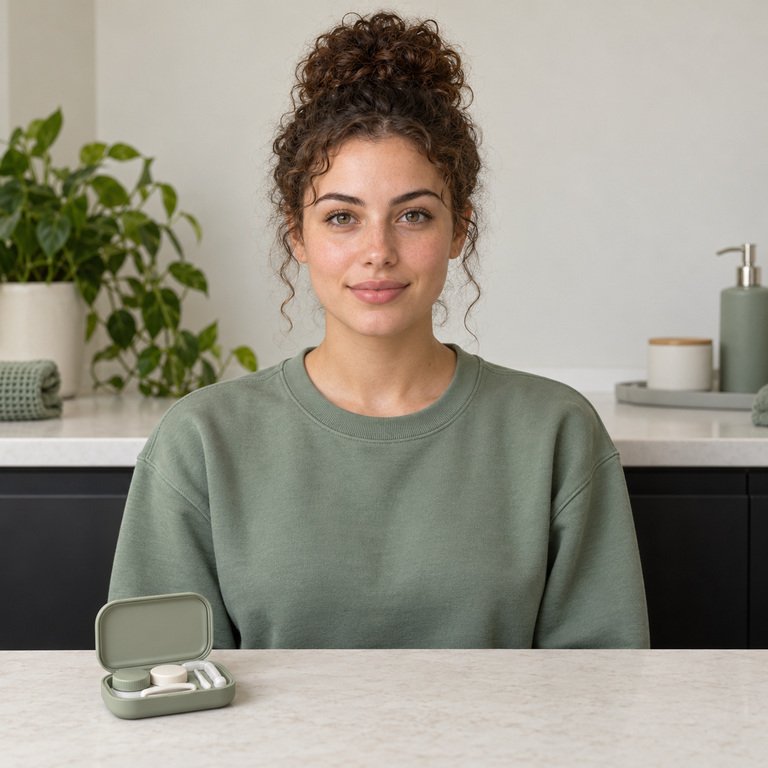
Colored contact lenses are prescription medical devices, so the first decision is not whether a tool looks convenient. It is whether the lenses were prescribed and fitted, and whether the eye care professional and manufacturer directions permit that handling method. For many soft lenses, clean, fully dry fingertips remain the standard method described in care instructions. Use an applicator only when it is intended for the exact lens and task, its directions explain safe cleaning and storage, and your eye care professional agrees that it suits your fitting needs. Never use sharp household tweezers or an improvised object near the eye.
The short comparison is simple: fingertips provide direct feedback and require fewer items to keep clean, while a purpose-made applicator may help with a specific handling difficulty but adds another contact surface, another cleaning routine, and another chance for contamination or lens damage. A tool does not cancel handwashing. Hands still touch the package, case, solution bottle, eyelids, or tool, so clean preparation remains essential whichever route is chosen.
Why this is a safety question, not a gadget preference
A colored lens rests directly on the eye. That makes handling different from applying makeup or placing a costume accessory. The FDA explains that decorative lenses require a prescription and a proper eye measurement and fitting. Fit, lens material, replacement schedule, care system, and the condition of the ocular surface all matter before insertion technique enters the conversation.
Online videos often reduce insertion to a quick trick: balance the lens on something, hold the lids, and place it. What disappears from the frame is the care system around that action. Was the device designed for soft contact lenses? Can it be disinfected by a method compatible with its material? Was it allowed to dry without touching a sink or counter? Is its tip intact? Did a clinician recommend it for that person? Without those answers, a tool can add uncertainty rather than control.
Start with the written instructions supplied with the prescribed lens, the solution, and any purpose-made device. If those instructions conflict, pause and ask the prescriber which method applies. Do not combine fragments from unrelated tutorials, because a technique for a rigid lens, a scleral lens, or a different device may not transfer to a soft colored lens.
What clean fingertip handling actually requires
Fingertip handling does not mean touching a lens casually. It means using a repeatable hygiene sequence. The National Eye Institute advises washing and thoroughly drying hands before touching contact lenses. A wet fingertip may make a soft lens difficult to control, while lint, lotion, food oil, cosmetics, nicotine residue, and household chemicals can transfer from hands to the lens.
Use the pad of a finger rather than a nail. Nails can nick a soft lens or scrape the eye, and a lens can hide against the nail edge. Keep nails smooth and use bright, steady lighting. Work over a clean, dry area away from an open drain. If a lens falls onto the counter or another questionable surface, do not put it straight into the eye. Follow the lens and care-solution directions for cleaning and disinfection, or discard it if it is a daily disposable or the directions do not provide a safe recovery method.
Before insertion, inspect the lens in the fingertip bowl. Check that it is right side out, free from visible debris, and not torn, chipped, dried, or folded onto itself. A damaged lens is not rescued by skillful placement. Replace it and contact the seller or eye care office if the package appeared defective. The blister pack inspection checklist explains what to review before a lens ever reaches the hand.
Hands also matter during removal. Dry fingertips usually grip a soft lens more predictably than wet ones, but removal technique should come from the prescriber. Long nails change the risk and mechanics, so review the long-nail removal guide and ask for an in-office demonstration rather than substituting pointed objects.
What counts as an appropriate applicator tool
An appropriate tool is a device made for contact-lens handling, identified for the relevant lens type and task, supplied with usable directions, and accepted by the prescribing professional. The package should explain whether it is for insertion, removal, or both. It should also identify any limits, cleaning method, replacement schedule, and storage requirements. A generic label such as “lens helper” is not enough to establish compatibility.
Some devices sold for specialty rigid or scleral lenses use suction or a plunger-like design. That does not make them suitable for ordinary soft colored contacts. Other products include soft-tipped tweezers intended only to lift a lens from a case, not to approach the eye. Treat the stated task as a boundary. If the labeling says the device is for case transfer, do not reinterpret it as an insertion or removal instrument.
Manufacturer inclusion is also not a blanket approval for every person. An eye care professional may identify eyelid control, reduced hand mobility, tremor, limited vision in one eye, anxiety about touching the eye, or another practical issue that changes the training plan. The useful question is: “Can you show me the method with my prescribed lens and confirm how this device should be cleaned?” A supervised demonstration can reveal whether the tool improves control or merely moves the difficulty to another step.
Never adapt cosmetic tweezers, eyebrow tweezers, craft tools, cotton swabs, fingernail tools, or other household objects. Sharp or rigid edges can tear a lens and injure the cornea or conjunctiva. Even a rounded household item lacks validated contact-lens directions and may retain residue in seams or coatings. If the approved device is lost or damaged, return to the method authorized by the prescriber or use backup glasses until a suitable replacement is available.
Applicator tools vs clean fingertips
| Decision point | Clean, dry fingertips | Purpose-made applicator |
|---|---|---|
| Direction support | Commonly described in public contact-lens care guidance and many soft-lens instructions | Use only when the device, lens maker, and eye care professional directions support the specific task |
| Contact surfaces | Finger pad and lens, plus the normal package or case | Hands still matter, and the tool adds a surface that must remain clean and undamaged |
| Tactile feedback | Direct feedback may help detect folding, slipping, or unexpected resistance | Feedback varies by design; force can be harder to judge if training is poor |
| Cleaning burden | Wash with soap and water, then dry completely with a clean, low-lint cloth | Follow the device’s exact cleaning, drying, storage, and replacement directions |
| Damage concerns | Nails and rough skin can nick a lens if technique is careless | Cracks, rough edges, degraded tips, or excess suction can damage a lens or eye |
| When to pause | Hands are not clean and dry, or insertion causes pain or repeated difficulty | Compatibility is unclear, instructions are missing, or the tool cannot be cleaned as directed |
This table is not a scorecard. A tool is not automatically safer because it keeps one fingertip away from the lens, and fingertips are not automatically suitable when a person cannot carry out the method reliably. The safer choice is the method supported by the prescribed product instructions, demonstrated when needed, and performed without pain, force, or contamination.
Why a tool does not replace hand hygiene
People sometimes buy an applicator because they do not want to touch the lens. Yet the hand usually opens the blister, handles the case cap, holds the eyelid, steadies the device, and closes the solution bottle. Unwashed or damp hands can transfer material to those surfaces even if a fingertip never touches the center of the lens.
Prepare the whole workspace before opening the package. Wash and dry hands, set out the approved supplies, place backup glasses nearby, and make sure the tool has completed its required cleaning and drying cycle. Do not place a cleaned device on a sink rim, used towel, makeup bag, phone, or countertop. A clean tool should have a clean, dry storage location that protects its contact end.
Hand sanitizer is not a substitute immediately before lens handling when soap and water are available. Sanitizer, moisturizer, fragrance, or incomplete drying may leave residue. If hands have recently handled chili, onions, cleaning products, adhesive, nail products, hair products, or oily foods, wash carefully and wait until they are clean, rinsed, and fully dry. The broader handling contamination guide covers workspace and transfer points that are easy to overlook.
Cleaning and storing an approved tool
There is no universal cleaning recipe for every applicator material. Follow the device maker’s instructions exactly. Do not boil, microwave, soak in alcohol, wipe with household disinfectant, or expose a tool to hydrogen peroxide unless its labeling specifically directs that method. Heat and chemicals can warp plastic, degrade a soft tip, leave residue, or change the surface that contacts the lens.
If the tool directions call for a particular contact-lens solution, use that product and respect the stated contact time. Saline may rinse, but it does not necessarily disinfect. Multipurpose and hydrogen peroxide systems are not interchangeable, and peroxide requires the correct neutralizing case. The saline and multipurpose solution comparison and peroxide and multipurpose system guide explain why solution labels matter.
After cleaning, let the device dry in the manner specified by its manufacturer. Store it in a clean, ventilated container if directed, separate from cosmetics and loose bathroom items. Do not seal it while wet unless the instructions require wet storage in a named solution. Never share an applicator. Sharing transfers biological material and makes the cleaning history impossible to verify.
Inspect the device under good light before every use. Retire it if the tip is cracked, sticky, cloudy, hardened, rough, misshapen, discolored, or loose. Also replace it at the stated interval even if it looks normal. If there is no cleaning or replacement guidance, ask the manufacturer and eye care professional before using it. Missing directions are not an invitation to invent a routine.
How tools can damage or contaminate a lens
A soft lens is thin and flexible. Pinching it too firmly, dragging it across a rough edge, or pulling it with inappropriate suction can create a small tear. A damaged edge may feel scratchy, move poorly, or fold under the eyelid. Do not keep trying to center a torn lens. Remove it with the approved technique, discard it, and use glasses.
Contamination is often less visible. Residue can remain in a hollow tip, joint, cap, textured grip, or storage cup. Touching the tool end to the sink, case rim, lashes, skin, or a previously handled lens changes its cleanliness. Rinsing briefly does not necessarily disinfect it. The cleaning method needs an adequate product and the contact time specified in the directions.
A tool can also contaminate the original solution or lens case if it is dipped repeatedly. Do not return used solution to a bottle, and do not top off old case solution. Read the fresh-solution guide and the bottle-tip contamination guide for related boundaries. Keep the solution nozzle from touching fingers, lenses, devices, counters, or the case.
A practical decision sequence
First, confirm that the colored lenses are current, prescribed, and fitted. Second, read the lens instructions and identify the insertion and removal method they describe. Third, ask the eye care professional to observe the technique if handling is difficult. Many problems can be corrected by adjusting hand position, eyelid control, gaze direction, lighting, mirror placement, or drying rather than adding equipment.
Fourth, if a tool is proposed, identify its manufacturer, intended lens type, intended task, cleaning method, storage method, and replacement point. Bring the actual packaging to the appointment or send the office a clear image of the label. Do not rely on a marketplace title or influencer caption. Fifth, practice only as directed and stop if the device requires force, repeatedly folds the lens, touches the eye with a hard edge, or cannot be kept clean.
Finally, keep backup glasses available. Handling should not become a contest against the clock. If insertion is failing, the eye is becoming irritated, or supplies are questionable, stop for the day. Repeated attempts can increase irritation and make the next attempt harder to judge.
When to remove the lens and seek help
Pain, marked redness, light sensitivity, discharge, sudden blur, unusual tearing, or symptoms that continue after removal need prompt professional attention. The FDA advises contacting an eye care professional right away for redness, eye pain that does not go away, or decreased vision. Do not use an applicator to probe for a lens or scrape at the eye.
If a lens seems lost, it cannot travel behind the eyeball, but it can fold under an eyelid. Wash and dry hands, stop using sharp objects, and contact an eye care professional if the approved removal steps do not work or discomfort persists. Bring the lens package, solution, case, and applicator to the visit if the office requests them. Those items can help clarify what contacted the eye.
The bottom line for colored contact users
Clean, fully dry fingertips remain a normal handling method in many soft contact-lens directions. A purpose-made applicator can be reasonable for a defined need only when its intended use matches the prescribed lens, its cleaning and storage instructions are clear, and an eye care professional supports the technique. The device adds responsibilities rather than removing them.
Choose the method that you can perform gently, consistently, and exactly as directed. Keep hands clean, protect every contact surface, inspect lenses and tools, and stop when something hurts or looks damaged. For broader routines, use Yilala’s cleaning and storage guide and colored contact removal guide alongside the instructions for your prescribed product.
Frequently asked questions
Are applicator tools safer than fingers for colored contacts?
Not automatically. Clean, fully dry fingertips are standard in many soft-lens instructions. A purpose-made tool may help a specific difficulty, but only when it matches the lens and task, can be cleaned correctly, and is supported by the manufacturer and eye care professional.
Can I use household tweezers to pick up or remove a lens?
No. Never use sharp household tweezers, cosmetic tweezers, or improvised objects near the eye. They can tear a soft lens or injure eye tissue. Use the authorized fingertip method or a purpose-made device specifically directed for that task.
Do I still need to wash my hands if I use an applicator?
Yes. Hands touch the package, lids, case, bottle, and device. Wash with soap and water, rinse thoroughly, and dry completely with a clean, low-lint cloth before handling any lens supplies.
Can I clean an applicator with alcohol?
Only if the device manufacturer explicitly directs it. Alcohol can damage some materials or leave an unsuitable surface. Do not create a cleaning routine from household disinfectants. Follow the named cleaning product, contact time, drying method, and replacement schedule.
Can a soft-tipped tweezer touch my eye?
Do not assume it can. Some soft-tipped tools are intended only to transfer a lens from a case. Keep any device away from the eye unless its labeling and your eye care professional specifically support eye contact for that exact use.
What if the applicator tip becomes sticky or cracked?
Stop using it. A changed surface can retain residue, grip unpredictably, or damage the lens. Replace the device according to its instructions and use backup glasses or an approved alternative until a suitable replacement is available.
What should I do if insertion keeps failing?
Pause rather than repeating attempts until the eye is irritated. Check lens orientation, hand dryness, lighting, mirror position, and eyelid control. Ask the eye care professional to watch the technique and recommend changes or an appropriate device if needed.
When should I contact an eye doctor after using a lens tool?
Remove the lens and seek prompt advice for pain, significant redness, light sensitivity, discharge, sudden blurred vision, unusual tearing, a suspected scratch, or symptoms that continue after removal. Do not probe the eye with the tool.