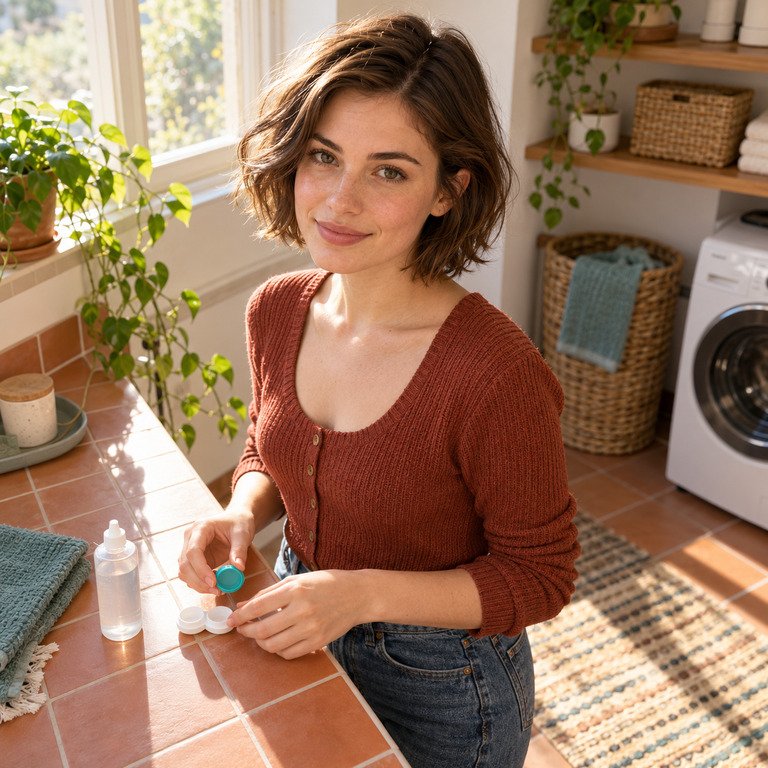
Do not top off a contact lens case. Empty every drop of used solution, clean the case as directed for your care system, let the empty case dry as directed, and use fresh disinfecting solution for the next storage cycle. Adding new solution to old solution can reduce disinfection effectiveness and carry contamination from the previous cycle into the next one.
In the United States, the FDA treats colored and decorative contacts as prescription medical devices, including lenses with no vision correction. Get a current contact lens prescription and a professional fitting before buying or wearing them. Your prescriber should also confirm which lens-care system is compatible with the prescribed lens. If an eye becomes painful, red, light-sensitive, suddenly blurry, unusually watery, or develops discharge, remove the lenses and contact an eye care professional promptly.
This guide covers reusable soft colored contacts and ordinary storage routines. It does not replace the instructions on your solution bottle, lens packaging, special case, or prescription. Those directions control when they differ from a general routine, especially for hydrogen peroxide systems and rigid gas permeable lenses.
Why topping off is not a harmless shortcut
Topping off means pouring fresh solution into a case that still contains old or used solution. It can look economical because the wells already seem partly full, but the remaining liquid is not a clean starter supply. It has already been through a storage cycle with the lenses and case. It may contain tear-film material, deposits removed from the lenses, and microorganisms introduced through handling.
Fresh disinfecting solution is formulated and labeled to work at its intended strength, volume, and contact time. When it is mixed with used liquid, you no longer have a fresh disinfection cycle. The National Eye Institute says never to mix old and new solution and to use fresh solution each time because topping off reduces disinfection effectiveness. The FDA likewise directs wearers to discard leftover solution after every use and never reuse lens solution.
The problem is not simply that the old solution looks cloudy or dirty. Used solution can look clear. Appearance cannot confirm that the liquid retains the labeled disinfecting performance or that the case is free of contamination. A quick splash of new solution does not reset the chemistry, remove material from the case surfaces, or restart the manufacturer’s process from a known condition.
Think of each disinfection cycle as a fresh, measured process rather than a reservoir that can be refreshed indefinitely. The starting point should be an empty, appropriately cleaned case and new solution taken directly from its original bottle. If there is not enough fresh solution to complete the labeled fill and soak, wear glasses and obtain more solution instead of stretching what remains.
What to do with the case after the lenses come out
For a conventional case used with multipurpose solution, the current public-health sequence is straightforward: wash and fully dry your hands, empty both wells, rub and rinse the case with fresh solution, remove the excess, and leave the open case to dry as directed. The National Eye Institute describes dumping out solution, drying a conventional case with a clean tissue, and storing it open and upside down, while your specific case and solution directions determine the exact setup. The FDA also advises rubbing and rinsing with fresh multipurpose solution and air-drying the case after lenses are removed.
- Wash and dry your hands. Use soap and water, then dry with a clean cloth before touching the lenses, caps, or case wells.
- Put the lenses on only if they are comfortable and appropriate to wear. If either lens or eye seems abnormal, stop and follow your eye care professional’s instructions.
- Discard all used solution. Empty both wells. Do not save the liquid in another container, and do not leave a shallow layer for later.
- Rub and rinse the case with fresh solution. Use the solution and technique specified by the product label and your prescriber. Include the wells and caps when the directions call for it.
- Remove excess liquid. Shake out or wipe away excess only as the official or product directions specify. Use a fresh, clean tissue if the directions call for one.
- Let the empty case dry. For a standard flat case, current professional guidance calls for keeping it open and dry between uses, with the exact position set by the case and solution directions. Keep it away from sink splash, toilet aerosols, cosmetics, and damp enclosed bags.
- Start storage with fresh solution. At the next removal, use new solution from the original labeled bottle and fill to the level required by the case and product instructions.
The Yilala guide to replacing a colored contact lens case explains why a case also needs a retirement date even when it is cleaned after each use. For the transfer from case to fingertip, the clean handling guide focuses on dry hands, clean contact points, and avoiding questionable surfaces.
Never use water to stretch or clean the system
Never pour tap, bottled, distilled, filtered, or homemade water into a lens case. Do not use water to rinse the case or lenses, and do not add water to concentrated or nearly empty solution. Water is not contact lens disinfecting solution. It can expose lenses and cases to organisms that may harm the cornea.
The National Eye Institute’s contact lens guidance says to use contact lens solution for cleaning, rinsing, and storage, never water or saliva. It also advises fresh solution each time and describes emptying, drying, and storing a conventional case open and upside down. If water gets on a lens or into the case, follow the lens, solution, and clinician directions rather than inventing a home decontamination method.
Saline and rewetting drops are not automatic substitutes. Saline may be labeled for a specific rinsing step, but it does not disinfect lenses. Rewetting drops are made for their labeled eye-use purpose, not overnight disinfection. The safe category is not simply any sterile-looking liquid. Use the exact product type recommended for the lens and care system.
Multipurpose solution and peroxide systems are not interchangeable
Most reusable soft-lens routines use multipurpose solution, which can clean, rinse, disinfect, and store when used according to its label. The routine still depends on fresh solution, the required rub and rinse steps, the correct fill level, and the full disinfection time. A bottle that says “no rub” does not give permission to ignore case cleaning or a prescriber’s instructions.
Hydrogen peroxide systems follow a different design. They require the special case supplied for neutralization and the full labeled soak time. Never put non-neutralized peroxide directly in the eye, rinse a lens with it immediately before insertion, or pour it into an ordinary flat case. The FDA’s peroxide guidance says to use the case that comes with each new bottle and to complete the required neutralization period.
Do not assume that a familiar flat case can replace a peroxide case because both have two lens holders. The neutralizing component is part of the peroxide system. Likewise, do not clean that special case with a generic routine unless its instructions direct you to do so. When the bottle, case insert, and general online advice seem inconsistent, pause use and ask the prescribing office or product manufacturer for clarification.
The Yilala overview of solution types for colored contacts can help you identify the broad categories, while your current product label and prescriber determine the actual system. The name on the front of a bottle is not enough; read the purpose, compatible lens type, warnings, opening-discard period, and required contact time.
A decision table for common case situations
| Situation | What not to do | Safer response |
|---|---|---|
| Old solution remains after lens insertion | Add fresh solution and close the case | Discard all liquid, clean and dry the case as directed, then use fresh solution for the next cycle |
| Bottle is nearly empty | Dilute it, mix brands, or underfill the wells | Use glasses until you have enough unexpired recommended solution for the full labeled process |
| Case was rinsed with tap water | Top it off and assume solution will correct the event | Keep lenses out and ask your eye care professional how to handle the case and lenses; replace the case when advised |
| Solution type is uncertain | Guess from bottle color or use it as multipurpose solution | Read the original label and instructions; contact the manufacturer or prescribing office if identification remains uncertain |
| Hydrogen peroxide case is unavailable | Use a standard flat case | Do not run the peroxide cycle; use glasses until the correct supplied case and full instructions are available |
| Eyes hurt or vision changes | Try another soak and keep wearing the lenses | Remove the lenses and contact an eye care professional promptly |
These responses are intentionally conservative. A lens-care shortcut can move contamination or product error closer to the cornea. Backup glasses make it easier to stop rather than improvise. The Yilala eye-exam guide for colored-contact wearers explains why follow-up and fit review remain relevant after the original purchase.
Small habits that keep fresh solution fresh
Fresh solution only helps if it stays in the bottle as the manufacturer intended. Keep the cap closed between uses. Do not touch the bottle tip to fingers, lenses, case rims, counters, or towels. Do not wipe the tip with a bathroom cloth. If the tip touches a questionable surface, follow the manufacturer’s advice rather than rinsing it with water or continuing as though nothing happened.
Keep solution in its original labeled container. Pouring it into a travel bottle can introduce contamination and separates the liquid from its directions, lot information, expiration date, and discard-after-opening instructions. Pack a manufacturer-sealed travel size when available. The bottle’s printed expiration date and its opening-discard period are separate limits, and the earlier applicable limit controls.
Do not combine the last amount from one bottle with a new bottle. Do not mix brands or care systems in the case unless an eye care professional and both product labels specifically support the sequence. Even products described with similar words can use different preservatives, cleaning steps, cases, or soak times.
A simple routine can reduce guesswork: mark the bottle’s opening date, mark the case’s first-use date, set replacement reminders, and keep glasses nearby. The Yilala cleaning and storage guide provides a broader reusable-lens checklist, and the Yilala quality and compliance page provides brand-level context. Neither changes the individual prescription or the care product’s directions.
What if the case sat with old solution for days?
Do not treat the liquid as usable because the caps stayed closed. The disinfecting cycle and labeled storage interval depend on the specific solution system. Discard the old liquid. Before wearing the lenses, check the product instructions for how long lenses may remain stored, whether they require a fresh disinfection cycle, and what to do after a storage interval has been exceeded.
If you cannot determine how long the lenses have been sitting, which solution was used, whether the solution was fresh, or whether the case remained clean, leave the lenses out. Contact the prescribing office for instructions. Replacing a questionable reusable lens may be the sensible response, but lens type, replacement schedule, contamination event, and eye condition all affect that decision.
Never use smell, color, or a quick visual inspection as proof that a stored lens is ready for the eye. A lens can look normal while the care history is uncertain. The Yilala storage guide offers additional organization ideas, but any specific timing statement must yield to the current label and your prescriber’s advice.
When to stop home care and call
Remove the lenses and seek professional advice when you have eye pain, redness, light sensitivity, sudden blurry vision, unusual watering, discharge, persistent discomfort, or a feeling that does not settle after removal. Do not repeatedly rinse and reinsert a lens to test the eye. Keep backup glasses available so vision needs do not pressure you into continuing wear.
Also call when a contamination event is difficult to classify. Examples include a case filled with an unknown liquid, solution shared between users, a peroxide system used in the wrong case, water exposure, a damaged case, or a bottle with a questionable tip or unknown opening date. Tell the clinician the lens brand, prescription, care product, case type, timeline, and symptoms. Bring the packaging if asked.
For shopping context, remember that cosmetic appearance does not change the medical-device status of colored contacts. A valid prescription identifies the prescribed brand and lens specifications, and professional fitting checks how that lens behaves on your eye. Browse Yilala colored contact information and products only after those prescription and fitting steps are addressed.
Official Sources
- U.S. Food and Drug Administration: Contact Lens Solutions and Products
- U.S. Food and Drug Administration: Decorative Contact Lenses for Halloween and More
- National Eye Institute: Contact Lenses
- U.S. Food and Drug Administration: Hydrogen Peroxide Solution
Frequently asked questions
Can I add fresh contact lens solution if only a little old solution remains?
No. Empty the case completely and start the next storage cycle with fresh solution. Even a small amount of used liquid means you are mixing old and new solution, which can reduce disinfection effectiveness.
Should I rinse my contact lens case with tap water before refilling it?
No. Keep water away from contact lenses and their case. For a standard multipurpose system, rub and rinse the case with fresh recommended solution, then empty and dry it according to current product and professional directions.
Can saline replace disinfecting solution in the case?
Not by itself. Saline does not disinfect contact lenses. Use it only for a step specifically included in your prescribed or labeled care system, and use the required disinfecting product for storage.
Do I need to let the case dry if I will use it again that night?
Yes, follow the case and solution directions after each use. For a conventional case, public-health guidance calls for removing used solution, cleaning with fresh solution, and storing the empty case open to dry, commonly upside down with caps off.
Can I use an ordinary flat case with hydrogen peroxide solution?
No. Hydrogen peroxide systems require their supplied special neutralizing case and the full labeled neutralization time. An ordinary case cannot be assumed to neutralize peroxide, and non-neutralized peroxide can injure the eye.
What should I do if I accidentally topped off the case?
Do not use the mixed solution as a completed disinfection cycle. Keep the lenses out, discard the liquid, and consult the product instructions. If the correct response for the lenses is unclear, ask your eye care professional before wearing them.
Is solution still fresh if the bottle is not expired?
Not necessarily. A bottle can have a discard-after-opening limit that arrives before the printed expiration date. It may also be questionable if the tip was contaminated, the cap was left open, or the liquid was transferred. Follow every applicable label limit.
When should eye symptoms become an urgent concern?
Remove lenses and contact an eye care professional promptly for pain, red eyes, light sensitivity, sudden blurry vision, unusual watering, discharge, or worsening symptoms. Do not keep wearing lenses while trying different case-cleaning routines.