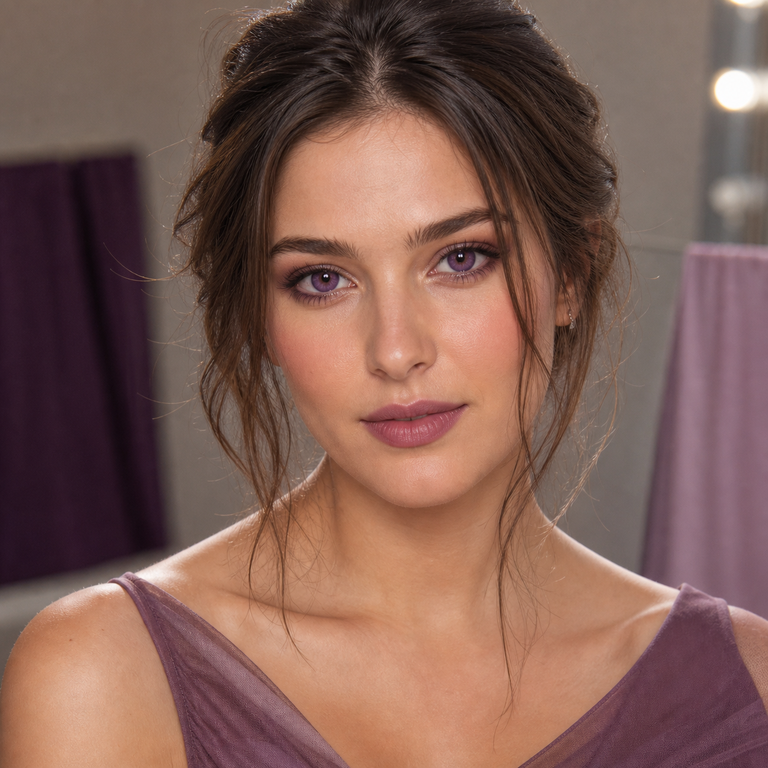
When I compare INYX Purple vs Berry Purple colored contacts, I do not start by declaring one universally prettier. I start with creative direction. Yilala presents INYX Purple within a bolder, more graphic series, while Berry Purple belongs to a softer, blended series. That distinction can help shape a beauty brief, but it is catalog positioning, not a promise that either lens will produce a particular shade, opacity, enlargement, or level of coverage on your eyes. The published primary specifications are otherwise closely aligned: both list HEMA+NVP material, a 14.2 mm diameter, an 8.6 mm base curve, 38% water content, plano through -4.50 powers, and a listed six-month replacement period after opening. In this guide, I separate those verified listing facts from creative interpretation so you can make a more precise choice without turning merchandising language into an unsupported wear claim.
My short answer
My edit is simple: begin with INYX Purple when the concept needs a more defined, statement-led purple direction; begin with Berry Purple when the brief calls for a softer, romantic purple direction. Those are series-level design cues taken from the listings. They do not establish how dark, bright, cool, warm, opaque, natural, or transformative either option will look on a particular iris. For a closer look at each collection’s catalog identity, I would open the INYX Series guide and the Berry Series guide before deciding.
Because the core listed measurements match, this is not a case where I would use diameter, base curve, material, water content, prescription range, or replacement schedule to manufacture a dramatic difference. The meaningful editorial distinction is the intended visual mood. The meaningful clinical decision is whether the prescribed product and measurements are appropriate for your eyes. A cosmetic preference cannot answer that second question.
What the product pages actually establish
The INYX listing identifies model HC1421 and includes INYX Purple among its color options. Its primary specification panel lists HEMA+NVP, 14.2 mm diameter, 8.6 mm base curve, 38% water content, and powers from 0.00 through -4.50. It lists six months after opening. The page describes the INYX Series with “bold, vivid tones” and a “striking limbal ring.” I treat that final sentence as Yilala’s collection description, not as measured opacity or a certain effect on every eye. View the INYX product listing.
The Berry listing identifies model HC1420 and includes Berry Purple alongside Berry Grey and Berry Brown. Its primary panel lists the same material, diameter, base curve, water content, power span, and after-opening replacement period. Yilala describes the Berry Series with “soft blended tones” and a “romantic, dreamy” direction. Again, that is useful art direction, but it is not evidence of a universal on-eye outcome. View the Berry product listing.
I use the 14.2 mm diameter shown in the primary specification area for both products. Each page also contains a lower descriptive block that says 14.5 mm, creating an internal listing inconsistency. Rather than silently choosing the more dramatic number, I would verify the current package labeling and prescription details before purchase. That discrepancy does not change the editorial comparison, but it is exactly the kind of detail a premium comparison should surface rather than hide.
Decision table: how I separate the two
Use this as a creative brief, then confirm fit and prescription professionally. “Catalog direction” records how Yilala positions the series; it is not a result certain on your iris.
| Decision factor | INYX Purple | Berry Purple | My editorial use |
|---|---|---|---|
| Model | HC1421 | HC1420 | Use the model number to verify the correct collection and packaging. |
| Catalog direction | INYX is described as bold and vivid, with a striking limbal-ring direction. | Berry is described as soft and blended, with a romantic, dreamy direction. | Choose defined statement styling for INYX; choose diffused romantic styling for Berry. |
| Published primary specifications | HEMA+NVP; 14.2 mm; BC 8.6 mm; 38% water | HEMA+NVP; 14.2 mm; BC 8.6 mm; 38% water | Do not claim a specification winner; verify the diameter discrepancy on the current label. |
| Listed powers | 0.00 to -4.50 | 0.00 to -4.50 | Both cover the same listed range; buy only with a valid contact-lens prescription. |
| Listed replacement | Six months after opening | Six months after opening | Treat this as an outer listed cycle, not continuous-wear permission. |
| Not established by the listings | Exact undertone, opacity, coverage, comfort, or universal on-eye effect | Exact undertone, opacity, coverage, comfort, or universal on-eye effect | Do not use assumptions in place of verified product and professional fit information. |
Why the shared specifications do not make them interchangeable
A matching specification line is useful, but it does not mean two colored lens designs are visually identical or clinically interchangeable. INYX Purple and Berry Purple use different model identifiers, HC1421 and HC1420, and sit in different collections. The printed color pattern is part of the product identity even when the headline measurements match. At the same time, I will not reverse-engineer unlisted opacity, pigment density, graphic diameter, undertone, or coverage from a product name or promotional image. Those properties are not quantified in the primary listings supplied for this comparison.
The shared 8.6 mm base curve and listed 14.2 mm diameter are product measurements, not a universal fit recommendation. Contact lenses rest on living eyes whose shape and health vary. The FDA states that all contact lenses, including decorative lenses, require a prescription, and that proper fit matters. That is why I treat “plano” as zero vision-correction power, not as “no prescription needed.” Read Yilala’s FDA compliance information alongside the FDA’s decorative contact lens guidance.
The same caution applies to the material and 38% water-content listing. Those data points identify published construction details; they do not allow me to promise comfort, breathability, hydration, or a safe number of wearing hours for an individual. I have not personally worn or tested either lens, and comfort reports from someone else would not establish your experience. Your prescriber and the approved instructions should determine fit, wear time, care, and replacement.
How I plan the INYX Purple look
For an INYX Purple concept, I would build the board around definition and intentional contrast because that is the series’ stated direction. I might pair it with clean liner, controlled lash placement, and a restrained lid so the eye design remains the focal point. A precise purple accent can repeat the idea without forcing an exact shade match.
I would test the palette in photographs before an event or campaign. Camera white balance, flash, ambient color, makeup, iris color, pupil size, and editing can alter how a lens appears. A listing photo is a reference, not a calibration target. Our guide to making colored contacts look natural in photos explains why consistent light and restrained editing are more useful than chasing one promotional image.
If the brief uses metallics, sharp tailoring, graphic eyeliner, or higher-contrast accessories, I would shortlist INYX Purple first. That is styling guidance, not a claim about opacity or brown-eye coverage.
How I plan the Berry Purple look
For Berry Purple, I would begin with diffusion because Yilala positions the Berry family as softer and more romantic. That could mean blurred shadow edges, separated lashes, a satin highlight, and lip and cheek tones that support rather than compete with the eyes. This is art direction, not a claim that Berry Purple has a particular undertone or will automatically look subtle.
I would compare the assembled look under neutral indoor light, daylight, and the actual camera setup. Cosmetic names are not standardized color measurements, and a lens reading differently from its product image does not by itself show a defect.
If you are still deciding between color families, see my pink vs purple colored contacts guide. For either lens, the colored contacts makeup guide covers a safer sequence: handle lenses with clean, dry hands, avoid contamination, and remove lenses before removing makeup. Professional and product instructions take priority.
Purple contacts for brown eyes: what I can and cannot promise
“Purple contacts for brown eyes” is a common shopping phrase, but brown eyes are not one uniform background. Iris pattern, lighting, camera processing, and lens design can affect the visible result. The listings do not provide a measured opacity percentage, coverage score, graphic diameter, or controlled comparison across brown irises. I therefore cannot say that one lens will be brighter, more opaque, more natural, or more effective on every brown eye.
Choose the design direction first, then reduce uncertainty. Review clearly labeled official images in consistent lighting when available, and do not treat unrelated customer photos as standardized evidence. Keep display settings and color filters in mind. If an exact event-day effect matters, plan a safe advance check with the prescribed product rather than building the makeup brief around an assumption.
For stronger-looking definition as a creative goal, INYX is the logical editorial starting point. For a softer narrative, Berry is the logical starting point. That preserves the catalog distinction without turning it into an unsupported coverage claim.
Prescription purple beauty lenses: power is only one part of the prescription
Both listings offer 0.00 and minus powers through -4.50, with steps shown from -1.00 through -4.50. That makes both relevant to a search for prescription purple beauty lenses, but availability of a number does not establish that it is your correct prescription. A contact lens prescription can include the brand, power, lens measurements, and expiration information; it is not safely replaced by copying a glasses prescription or selecting the closest dropdown value. Neither listing presents plus powers or astigmatism parameters in the supplied primary options. If you need either, do not improvise.
I also would not split one pair between people, exchange lenses, or choose a model solely because a friend wears it. The FDA warns not to share contacts and advises an eye exam and prescription for decorative lenses. A licensed eye-care professional should assess whether a lens fits properly and provide wearing and care directions.
For US readers, the safety baseline is straightforward: decorative lenses are medical devices even when their purpose is cosmetic. FDA registration language on a seller’s page does not replace an individual prescription, proper fitting, or correct use. I would verify the exact product, seller, labeling, and professional instructions rather than using “FDA registered” as a standalone guarantee about suitability for a particular person.
Care, replacement, and the six-month listing
Each primary listing says six months after opening. I read that as the listed outer replacement interval, not permission to wear a lens continuously for six months and not a promise that every opened lens remains suitable until that date. Wearing time per day, cleaning, disinfection, storage, lens condition, eye health, and professional instructions still matter. Replace a lens earlier if directed, damaged, contaminated, or otherwise unsuitable; never extend use simply to reach the advertised interval.
Yilala’s pages instruct users to wash and dry hands, use fresh contact lens solution, avoid tap water and saliva, clean and store lenses correctly, and remove them before swimming, showering, or sleeping. The CDC likewise emphasizes healthy contact-lens wear and care practices; its contact lens guidance is a useful public-health companion to product instructions. Never top off old solution, and do not transfer care rules from another lens without confirmation.
Redness, persistent pain, discharge, light sensitivity, blurred or decreased vision, or other concerning symptoms are not styling inconveniences. Remove the lenses and seek prompt eye-care advice; the FDA specifically warns that infection can become serious. I would postpone the look rather than troubleshoot symptoms through makeup, drops not approved for the lens, or a shorter photo session. No comparison verdict is more important than protecting vision.
My final edit
My purple colored contact lenses comparison comes down to two catalog moods built on largely shared specifications. INYX Purple, model HC1421, is my first shortlist for a defined, statement-led brief because INYX is presented as bold and limbal-ring focused. Berry Purple, model HC1420, is my first shortlist for a softer, romantic brief because Berry is presented as blended and dreamy. Neither conclusion predicts undertone, opacity, coverage, comfort, enlargement, or on-eye color.
Do not invent a technical difference where the listings show the same data. Use makeup, wardrobe, lighting, and photography goals to choose the direction; use an eye-care professional to decide what is appropriate to wear. Verify current packaging and prescription details, especially because the primary 14.2 mm diameter conflicts with a lower 14.5 mm line.
One safety boundary I will not edit around
I also keep the FDA Contact Lens Risks guidance beside this visual comparison. Pain, unusual redness, discharge, light sensitivity, or sudden blur changes the task from color selection to lens removal and professional advice.
Frequently Asked Questions
What is the main difference between INYX Purple and Berry Purple?
The clearest supported difference is collection direction and model identity. INYX Purple is model HC1421 in a series Yilala describes as bold and vivid with a striking limbal-ring direction. Berry Purple is model HC1420 in a series described as soft, blended, romantic, and dreamy. Their primary listed material, diameter, base curve, water content, power range, and replacement interval match. Those collection descriptions guide styling; they do not guarantee an on-eye result.
Which purple lens is more natural-looking?
I would not declare a universal winner for naturalness. Berry's softer catalog positioning may suit a more diffused makeup brief, while INYX's positioning may suit a more defined one, but “natural” depends on the wearer, lighting, lens fit, iris appearance, makeup, and personal preference. The listings do not provide controlled naturalness scores, measured opacity, or standardized on-eye comparisons.
Are INYX Purple or Berry Purple better purple contacts for brown eyes?
The listings do not establish which one covers or transforms brown eyes more strongly. They provide no measured opacity or brown-eye coverage comparison. I would start with INYX for a statement-led direction or Berry for a softer direction, then keep expectations flexible and assess the prescribed product safely in the lighting where it will be used.
Do both come as prescription purple beauty lenses?
Both product pages list plano 0.00 and minus powers through -4.50. That does not mean every prescription is supported, and a dropdown power is only part of a valid contact-lens prescription. The supplied options do not show plus powers or astigmatism parameters. An eye-care professional should prescribe the appropriate brand, fit, and correction.
Do INYX Purple and Berry Purple have the same size?
Their primary specification panels both say 14.2 mm diameter and 8.6 mm base curve. However, lower descriptive sections on both pages say 14.5 mm, so the pages are internally inconsistent. I would verify the current box, blister, prescription, and seller information rather than assuming either number. A matching published size also does not prove that a lens fits your eyes.
Can I wear plano purple contacts without a prescription?
No. Plano means there is no corrective power; it does not remove the need for a contact-lens prescription. The FDA says all contact lenses, including decorative lenses, must be prescribed by a doctor. Proper fit and professional directions matter because decorative contacts are medical devices, not ordinary cosmetics.
Does the six-month listing mean I can wear the lenses every day for six months?
No. It is the listed replacement period after opening, not a continuous-wear schedule or a promise of daily suitability. Follow the prescribed wearing schedule, care instructions, and any earlier replacement direction. Remove lenses before sleeping, swimming, or showering, and never continue wearing a damaged, contaminated, or symptomatic lens simply because six months have not passed.
Which one would I choose for a photo-focused makeup look?
I would shortlist INYX Purple for a graphic, contrast-led composition and Berry Purple for a softly blended, romantic composition. Then I would test the complete prescribed look under the intended camera, white balance, and lighting without relying on heavy color edits. That workflow plans the image honestly while avoiding an unsupported promise about how either lens will appear on a specific eye.