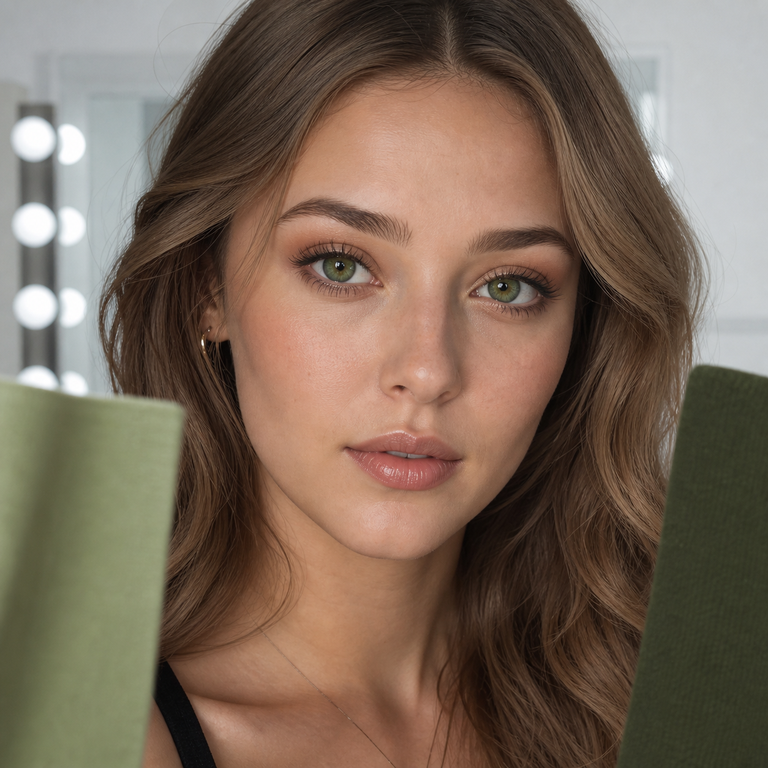
My direct answer: Illusory Green and INYX Green share the same published core specifications, so I would not choose between them by diameter, base curve, water percentage, material, prescription range, or listed replacement period. I would choose by the creative direction I am building: Illusory Green when the Illusory series is the clearer fit for an ethereal, light-led edit, and INYX Green when the INYX series gives the look a sharper, more graphic identity. Those are styling frameworks, not claims about opacity, undertone, enlargement, coverage, brightness, or on-eye performance.
That is the heart of my Illusory Green vs INYX Green colored contacts comparison: catalog evidence first, then lighting, makeup, wardrobe, and image intent. I have not worn or tested either lens, and I use no comfort anecdotes, compliments, or customer reports. Fit requires professional confirmation; appearance requires current imagery rather than assumptions.
My comparison standard: facts first, art direction second
As a brand editor, I separate what a listing verifies from what a photograph merely suggests. The verified product data for Illusory Green, model HE1102, and INYX Green, model HC1421, matches across every primary specification supplied for this comparison. Both are listed as HEMA+NVP lenses with a 14.2 mm diameter, an 8.6 mm base curve, 38% water content, powers from 0.00 through -4.50, and six months after opening as the listed period.
That shared data matters, but it does not answer every visual question. A diameter number does not prove visible enlargement. A material name and water percentage do not establish comfort for an individual eye. A green color name does not prove an undertone, and a product photograph does not let me promise identical results across iris colors, pupils, lighting conditions, cameras, displays, or production batches. I therefore keep my visual language in the realm of creative selection: which series concept supports the story, not which lens supposedly performs a visual trick that the specifications do not document.
For readers comparing the wider families, I would open the Illusory series guide and the INYX series guide alongside the live product pages. This prevents one green variant from carrying the burden of representing an entire collection. It also keeps the comparison current if color menus, packaging, availability, or page photography change.
Illusory Green vs INYX Green at a glance
| Decision point | Illusory Green | INYX Green | How I use it |
|---|---|---|---|
| Model | HE1102 | HC1421 | I use the model number to verify the intended listing before ordering. |
| Material | HEMA+NVP | HEMA+NVP | No specification-based winner. |
| Diameter | 14.2 mm | 14.2 mm | No claim about visible enlargement can be made from this tie. |
| Base curve | 8.6 mm | 8.6 mm | Matching numbers do not replace a professional fitting. |
| Water content | 38% | 38% | I do not translate this number into a comfort promise. |
| Listed powers | 0.00 to -4.50 | 0.00 to -4.50 | Both offer the same published power range; a valid prescription still governs selection. |
| Listed period | Six months after opening | Six months after opening | This is an outer listing limit, not permission to ignore care instructions, expiry information, or professional advice. |
| Editorial choice | My pick for an Illusory-led, airy narrative | My pick for an INYX-led, graphic narrative | A creative distinction only; confirm the actual appearance from current imagery. |
The table is intentionally conservative. It shows why this is not a specifications contest: the measurable fields supplied on the listings are tied. My final row describes how I organize a shoot or beauty story, not a measurable lens effect. If I need to know how either option reads on a particular iris, I do not extrapolate from the collection name. I ask for current, relevant imagery and preserve room for variation.
Why I would choose Illusory Green
I reach for Illusory Green when “Illusory” is the stronger editorial word for the brief. Perhaps the mood board is built around gauze, translucent accessories, diffused highlights, softened tailoring, or a narrative that moves between recognizable and dreamlike. In that setting, the series name gives the team a coherent verbal anchor. It helps me explain why the eye color belongs in the concept without claiming that the lens itself is translucent, pale, luminous, cool, warm, or naturally blended.
My lighting plan for that direction starts with restraint: a large source, window light, or controlled diffusion, checked against a neutral reference. I am not assuming the lens becomes brighter or softer; gentle light simply supports the narrative around it. For makeup, I build one quiet neutral board and one expressive alternative, then photograph both in the intended light. I never try to force a presumed undertone out of the name.
I also like Illusory Green when the campaign language needs softness without becoming vague. The model number HE1102 provides precision behind the poetry. I can label selects, call sheets, and product references with the exact model while letting “Illusory” guide the emotional register. That combination, accurate catalog control plus an evocative series identity, is what makes it my choice for this kind of direction.
Why I would choose INYX Green
I choose INYX Green when the INYX identity makes a cleaner, more decisive title card. The name feels suited to an edit built around polished surfaces, defined silhouettes, directional styling, or a compact color story. Again, that is my art-direction interpretation of the series identity. It is not evidence that HC1421 has a stronger limbal ring, greater opacity, higher contrast, more coverage, or any other unlisted visual property.
For lighting, I consider a controlled key and deliberate negative fill, with a softer setup as a truth check. The goal is a graphic frame, not a suggestion that harder light reveals a certain lens quality. I lock white balance and capture a neutral reference. My makeup board may emphasize measured liner, deliberate brows, and a precise skin finish, but the lip follows the wardrobe rather than a guessed lens undertone. I judge the full composition, not only a macro crop.
HC1421 is also the reference I would keep visible across production notes. When two options share all the headline specifications, exact identifiers reduce preventable confusion. “The green one” is not sufficient on a set or in a cart; “INYX Green, HC1421” is. That operational clarity is not glamorous, but it is part of a premium workflow.
How I decide when the specifications are tied
First, I verify the intended product and variant. I match the series name, green color option, and model number on the live listing. Second, I confirm that the available power is consistent with the wearer’s current contact-lens prescription; I never treat 0.00 as a shortcut around fitting or medical oversight. Third, I gather current product images that are relevant to the intended iris context and ask what is known about the lighting. Only after those checks do I evaluate creative fit.
Then I write a one-sentence image objective. For Illusory Green, that might be: “Create a refined, dream-adjacent beauty portrait in which green is part of a softened palette.” For INYX Green, it might be: “Create a polished, graphic beauty portrait in which green sits inside a controlled design system.” These statements guide the set while remaining agnostic about unverified lens effects.
Finally, I score concept language, wardrobe harmony, makeup flexibility, lighting compatibility, and truthful representation. One option can win for a project while the specifications remain tied; it is better aligned, not universally better. For a personal look, choose the series whose visual world fits, compare current unedited references where possible, and do not buy a promise the catalog has not made.
Green contacts for brown eyes: what I can and cannot conclude
The phrase green contacts for brown eyes often hides a request for certainty: “Will this exact green cover my exact brown iris in the way I imagine?” I cannot answer that from these specifications, and I will not rank Illusory Green against INYX Green on coverage. The listings identify the color choices and core lens data, but the supplied facts do not establish opacity or a certain transformation on brown eyes.
My responsible workflow is to consult the colored contacts for brown eyes guide, look for current references that resemble the intended starting iris, and note whether the example discloses its lighting. I compare multiple frames rather than relying on one highly graded hero image. I also remember that camera processing, screen settings, surrounding makeup, and ambient color can change how green is perceived in a photograph.
This is especially important in a green colored contact lenses comparison. Two products can share diameter, base curve, water content, material, prescription range, and listed period while still belonging to different catalog series. Yet those series names alone do not quantify what happens over a dark iris. If brown-eye coverage is the decisive requirement, the honest answer is to seek specific evidence before purchase rather than awarding a speculative victory.
My lighting and photography protocol
I begin with neutral, repeatable conditions. I set a stable white balance, use the same camera and lens, hold exposure as consistently as the face allows, and include a neutral color reference in setup frames. I capture a straightforward front-facing image before creative lighting. That baseline gives the team something more trustworthy than memory when evaluating the color story.
Next, I add campaign lighting one variable at a time. Diffused, directional, warm, and cool setups can change the total photograph, so I label them as lighting tests rather than proof of a fixed lens quality. If the final edit uses strong grading, I preserve a minimally processed frame for product review.
I follow the same restraint in retouching. I clean distractions and balance the image, but I do not paint the iris into an outcome the lens did not create. The guide to making colored contacts look natural in photos is the reference I would pair with this process. “Natural” here is a production goal, coherent light, believable color relationships, and proportionate sharpening, not a claim that either product is inherently more natural-looking.
For a premium result, consistency beats spectacle. My preference lets Illusory Green remain HE1102 and INYX Green remain HC1421, with the concept supplied by the set rather than invented in post.
My makeup selection approach
I treat eye makeup as framing, not camouflage. Before choosing shades, I map the wardrobe, skin finish, lip, brows, and background. Then I decide whether the eye area should lead the composition or support it. This avoids a common creative mistake: piling green around green before seeing how the actual product photographs in the planned setup.
With an Illusory-led brief, I may begin with quieter transitions and let texture do more work. With an INYX-led brief, I may begin with cleaner edges and a more deliberate shape. Those are starting points, not rules, and neither implies a known undertone or ring structure. I keep cotton swabs, remover, and alternate shades ready so the makeup can respond to the real frame rather than to a prewritten fantasy.
The broader colored contacts makeup guide can help organize that testing. My own rule is simple: test in the final light before adding complexity. A palette that looks harmonious at the makeup station may shift under strobes, LEDs, window light, or a warm practical. The image, not the pan, makes the decision.
Prescription, fit, care, and the six-month listing
Both pages list powers from 0.00 to -4.50, but these are still contact lenses. The U.S. Food and Drug Administration states that decorative contacts are medical devices and that all contact lenses, including decorative lenses, require a prescription. Its guidance warns that lenses obtained without a prescription or used incorrectly can cause corneal abrasion, allergic reactions, infection, decreased vision, and blindness. Review the FDA guidance on decorative contact lenses and their risks and Yilala’s FDA compliance information before treating either option as a purely cosmetic accessory.
A shared 8.6 mm base curve and 14.2 mm diameter do not prove that either lens fits a particular person. An eye-care professional should examine the eyes, provide the appropriate contact-lens prescription, and give wearing and care instructions. If redness, persistent pain, discharge, or decreased vision occurs, remove the lenses and seek prompt professional care, following FDA guidance.
The “six months after opening” line is the listed product period for both options; I read it as a maximum catalog limit, not a guarantee that every opened pair remains suitable for six months regardless of use or care. Earlier disposal may be required by the package instructions, damage, contamination, expiry, or professional advice. I record the opening date, retain the packaging and model information, and follow the prescribed replacement and care plan.
For daily prevention habits, I also use the CDC’s contact-lens infection-prevention guidance as a checkpoint. Hand hygiene, avoiding water exposure, using contact-lens solution correctly, caring for the case, and following the eye-care professional’s wear and replacement directions belong in the decision. No editorial concept is worth relaxing medical-device hygiene.
My final verdict
For Illusory Green vs INYX Green colored contacts, my verdict is a purposeful tie on published specifications and a split decision on creative direction. I choose Illusory Green HE1102 for a brief whose language and styling are ethereal, softened, and atmosphere-led. I choose INYX Green HC1421 for a brief whose language and styling are polished, structured, and graphic. These are first-person editorial preferences, not claims about how the lenses look or feel on an eye.
If prescription availability is the deciding factor, both listings publish the same 0.00 to -4.50 range. If technical dimensions are the deciding factor, both list 14.2 mm and an 8.6 mm base curve. If material, water percentage, or period is the deciding factor, both list HEMA+NVP, 38%, and six months after opening. None of those ties eliminates the need for a prescription, professional fit, proper care, or current product verification.
So my shortest buying rule is this: verify the model, confirm the prescribed parameters, inspect current relevant imagery, and select the series story that best completes the look. Illusory is my atmospheric edit; INYX is my graphic edit. Everything beyond that should be demonstrated, not invented.
The eye-safety limit on my green comparison
The FDA Contact Lens Risks guidance sets the stopping point. Pain, redness, discharge, light sensitivity, or sudden blur is a reason to remove the lens and contact an eye-care professional.
Frequently asked questions
What is the main difference between Illusory Green and INYX Green?
The clearest documented difference is the product identity: Illusory Green is model HE1102 in the Illusory series, while INYX Green is model HC1421 in the INYX series. Their supplied primary specifications match. I therefore distinguish them by series-led creative direction, not by unsupported claims about opacity, undertone, rings, enlargement, or on-eye results.
Which lens has the larger diameter?
Neither. Both product pages list a 14.2 mm diameter. I do not convert that shared measurement into a claim that they create the same visible enlargement, because diameter alone does not document an on-eye effect.
Do Illusory Green and INYX Green have the same base curve and water content?
Yes. Both are listed with an 8.6 mm base curve and 38% water content. Those matching figures are useful for catalog comparison, but they do not establish individual fit or comfort; that requires professional evaluation and a valid contact-lens prescription.
Which is better for brown eyes?
I cannot name a winner for brown eyes from the supplied specifications. Neither listing fact set establishes opacity or certain coverage. I would compare current images relevant to the starting iris, verify the lighting context, and use the brown-eyes guide before choosing.
Are these prescription green beauty contacts?
Both listings offer powers from 0.00 to -4.50, so they include powered options as well as 0.00. In the United States, decorative lenses still require a prescription even when they do not correct vision. Choose only the power and lens parameters prescribed for you.
Can I keep either pair for six months after opening?
Six months after opening is the period listed for both products. I treat it as an outer limit, not an unconditional promise. Follow the package, expiry, cleaning, storage, wear, and replacement instructions plus your eye-care professional’s direction, and discard earlier if instructed or if a lens is damaged or contaminated.
Which one looks more natural?
I do not have product-grounded evidence to rank naturalness. That judgment depends on the actual lens appearance in context, the wearer’s iris, lighting, makeup, camera, and expectations. I would review minimally edited references and build natural-looking photography through accurate light and restrained post-production.
How do I choose between HE1102 and HC1421?
Confirm your prescription and fit first, then verify the exact model and green variant on the live listing. If both remain suitable, choose HE1102 when the Illusory collection best supports an atmospheric brief, or HC1421 when the INYX collection best supports a graphic brief. Treat that as a styling preference, not a performance ranking.